
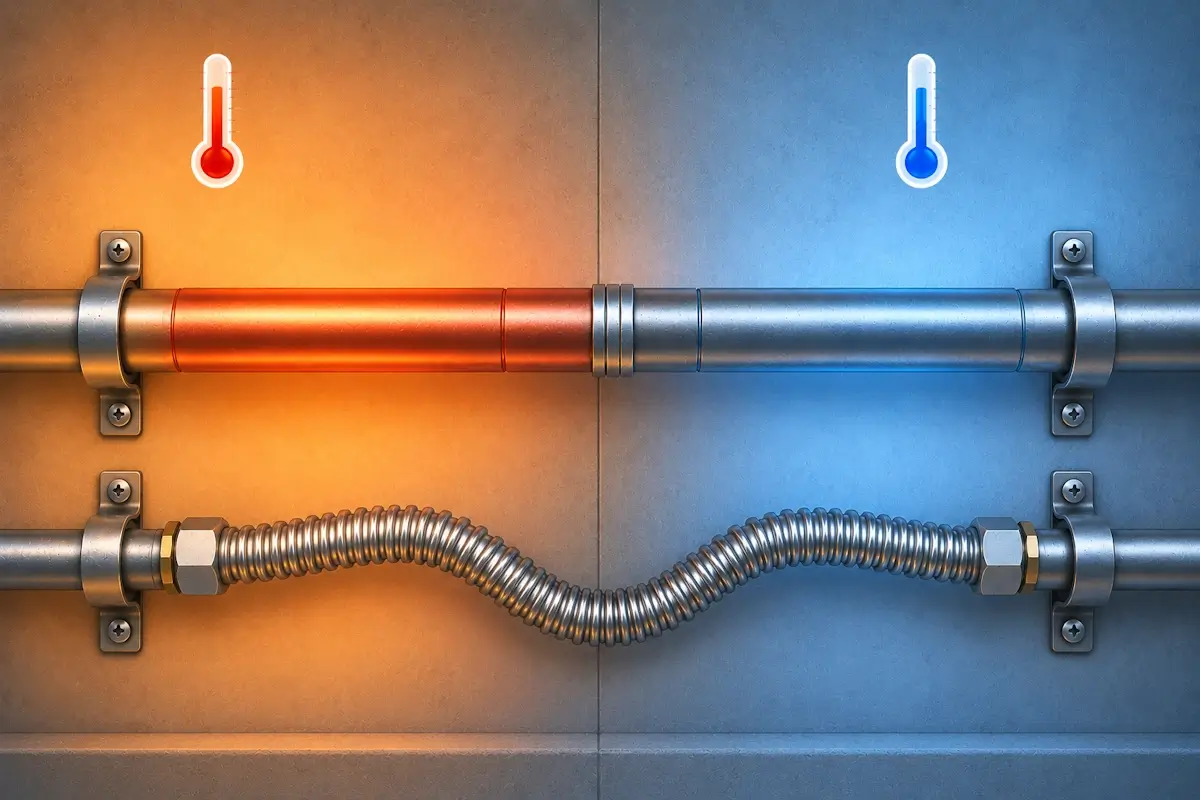
 Pipelines of heating systems, hot water supply and other engineering systems are constantly exposed to temperature changes. When heated, metal pipes expand, and when cooled, they contract. At first glance, these changes seem insignificant, but on long sections of the pipeline they can create significant mechanical loads.
If compensation for temperature deformations is not provided, over time cracks, damage to joints, deformation of fasteners, noise and even emergency situations may occur. In this article, we will consider why thermal expansion of pipelines occurs and what solutions help protect the system.
Why pipes expand when heated
The main reason is the property of materials to change their geometric dimensions depending on the temperature.
For example, a heating system pipeline in winter can heat up from room temperature to 60–80 °C and more. At the same time, the metal pipe increases in length. The longer the pipeline section is and the greater the temperature difference is, the greater the thermal expansion is.
In simplified terms, it depends on three main factors:
- pipe length;
- the coefficient of thermal expansion of the material;
- the difference between the initial and operating temperatures.
For example, a long straight section of pipeline, rigidly fixed at both ends, has practically no opportunity to freely change its length. As a result, thermal expansion is converted into mechanical stress inside the system.
How dangerous is thermal expansion of pipelines
If the system is designed without taking into account thermal deformations, various problems may arise.
- Load on connections. Pipe expansion is transferred to threaded, flanged, press and other connections. Constant heating and cooling cycles can gradually increase the load on the joints.
- Pipe deformation. A rigidly fixed pipeline can begin to bend, sag or shift relative to its original position.
- Damage to fasteners. With significant temperature movement, the load is transferred to clamps, brackets and other fastening elements.
- Noise. During heating, pipes can move in places where they pass through walls, ceilings or fasteners. This is often accompanied by characteristic clicking and cracking sounds.
- Load transfer to equipment. A particularly dangerous situation arises when the temperature movements of the pipeline are transmitted directly to boilers, pumps, heat exchangers, radiators or other equipment.
That is why compensation for temperature deformations must be provided for at the system design stage.
How to compensate for temperature expansions
There are several main ways to compensate for temperature movements of pipelines:
- Compensation loops. One of the common methods is to create a special loop from the pipeline. It allows the pipe to move during heating and cooling without excessive stresses. This solution is well suited for long pipelines, but requires additional space.
- U-shaped and other compensators. For certain systems, special geometric pipeline designs are used to provide the necessary mobility. Their parameters depend on the length of the section, temperature conditions, pipe material and installation conditions.
- Bellows compensators. Bellows compensators are designed to absorb axial and, depending on the design, other movements of the pipeline. They are widely used in heating systems, hot water supply and industrial installations.
- Flexible corrugated hoses. Another practical solution is to use flexible elements in individual sections of the pipeline. Stainless steel corrugated hoses have significantly greater flexibility compared to a rigid pipe. Due to this, they can compensate for certain movements and vibrations of the system, reducing the transmission of mechanical loads to the connected equipment.
This may be particularly relevant in connection points:
- heating equipment;
- boilers and water heaters;
- pumping equipment;
- heat exchangers;
- heat pumps;
- collectors;
- other equipment that can move or create vibrations.
Why use stainless steel for compensation
Corrugated stainless steel combines mechanical strength and flexibility. The corrugated design allows the hose to change shape during movement, and stainless steel provides corrosion resistance and long-term operation under appropriate conditions. Compared to a rigid section of the pipeline, a flexible element can much better absorb small movements associated with temperature cycles.
It is important to understand that a flexible hose is not a universal replacement for a full-fledged pipeline compensator. Its capabilities for compensating for temperature movements depend on the design, length, diameter, installation method and permissible bending radius.
Temperature expansion and heat pumps
The problem of temperature movements is particularly relevant for modern heating systems, in particular heat pumps. The equipment can create vibrations, and the pipeline regularly changes temperature during system operation.
Flexible corrugated stainless steel conduits in such cases can perform several functions at once:
- ensure convenient connection of equipment;
- compensate for small installation displacements;
- reduce vibration transmission;
- simplify installation;
- compensate for some temperature shifts.
However, during design, it is necessary to take into account all loads separately and correctly determine the required type of compensating element.
How to properly install a flexible hose
The effectiveness of a flexible element largely depends on the correct installation. Do not install the hose with excessive tension or use it as a lever to forcefully shift the pipeline. It is also necessary to adhere to the permissible bending radius and prevent the hose from twisting around its own axis.
Basic rules:
- Do not install the hose under tension.
- Do not allow sharp bends.
- Do not exceed the permissible bending radius.
- Do not use the hose to compensate for movements that exceed its design capabilities.
- Take into account the operating temperature and pressure of the system.
- Ensure the correct position of the fittings during installation.
- Avoid mechanical damage to the corrugation.
What to consider during design
To protect the pipeline properly from thermal expansion, it is not enough to simply install a flexible element. It is necessary to assess:
- pipeline length;
- pipe material;
- maximum and minimum operating temperature;
- temperature difference;
- working pressure;
- mounting method;
- presence of fixed and sliding supports;
- possible vibrations;
- movement of connected equipment.
Based on these data, it is determined whether a flexible conduit is sufficient or whether a special compensator is required.
Conclusion
Temperature expansion is a natural phenomenon for any pipeline that operates with variable temperatures. Problems arise when the system design does not allow the pipes to freely compensate for these movements.
Compensation loops, bellows compensators and other design solutions are used to protect pipelines. In some areas, flexible corrugated stainless steel hoses can be an effective solution, which help compensate for small movements, vibrations and simplify the connection of equipment.
A correctly selected and installed flexible element reduces the mechanical load on the pipeline and equipment and increases the reliability of the system in conditions of constant heating and cooling cycles.
