
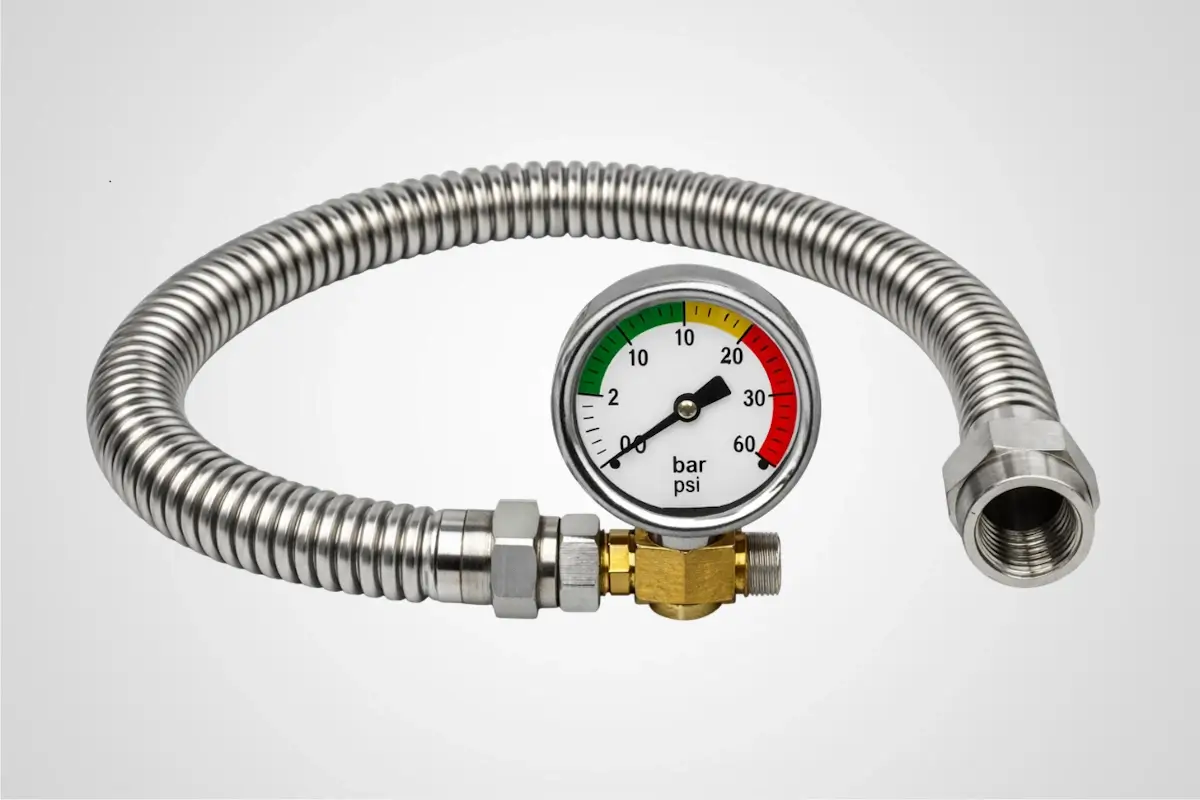
Corrugated hoses and metal sleeves made of stainless steel are a universal solution for connecting gas, water, heating and industrial equipment. Many people are concerned about the question: what pressure can they actually withstand and what factors affect the strength of the product?
What regulatory documents are used to determine the pressure in corrugated stainless steel hoses?
The main document is the European standard EN ISO 10380. It establishes requirements for corrugated metal hoses and metal hoses made of stainless steel, regulates their production, design, materials, testing and marking for use in various domestic and industrial systems.
EN ISO 10380 establishes mandatory tests, in particular:
- leak testing using pneumatic air testing and testing in a water bath;
- hydrostatic pressure testing, which checks the strength of the hose under pressure (usually 1.5 times the maximum allowable working pressure). This plastic deformation of the corrugation occurs and the hose is elongated. After the test, the length of the hose should decrease as close as possible to its original state. The elongation should not exceed 1%;
- bursting pressure test – a destructive test that determines the ultimate pressure at which the hose breaks. Typically, the burst pressure is at least 4 times the working pressure;
- cyclic endurance tests to check how the hose can withstand repeated bending and vibration;
- axial load tests to check the strength of the hose connection to the fittings;
- bending tests to determine the minimum bending radius at which the hose can operate without damage.
Eco-Flex, as a manufacturer of stainless steel hoses and metal hoses, carries out all these tests. On the website pages with descriptions of our products contain tables with technical characteristics, which indicate the permissible working pressure.
Working pressure for different types of corrugated hoses
Working pressure is the maximum pressure at which the hose can safely operate over its entire service life.
The working pressure varies for different types of stainless steel hoses:
- Domestic stainless steel gas hoses: up to 0.05 MPa (0.5 bar). This is the standard for the maximum pressure in gas networks, which is prescribed in DBN V.2.5-20:2018 “Gas supply. Engineering equipment of buildings and structures”. In fact, corrugated stainless steel hoses have a much greater margin of safety, especially those products that have a steel braid, such as the Eco-Flex Gas EN14800 hose.
- Water supply and heating hoses: up to 1.6 MPa (16 bar).
- Industrial metal hoses with braiding: up to 30 MPa (300 bar) and more (depending on the design).
What does the working pressure in corrugated metal hoses depend on?
1. Wall thickness and corrugation profile
The greater the metal thickness, the greater the safety margin. The corrugation type is also important. Eco-Flex hoses and metal sleeves can have three types of corrugation pitch:
- Closed – the most flexible hoses and metal hoses, withstanding low pressure;
- Standard – moderate flexibility and pressure;
- Open – least flexible, highest pressure.
The geometry of the corrugation directly impacts the ability to withstand internal pressure.
2. Presence of braiding
Unbraided metal hoses can withstand significantly lower pressures. The presence of one or two layers of steel braid:
- reduces axial elongation;
- increases permissible pressure;
- increases service life under pulsation.
Therefore, high-pressure hoses (up to 300 bar) always have a reinforced design.
3. Hose diameter
As the internal diameter increases:
- the load on the walls increases;
- the permissible working pressure decreases.
This means that a hose with a diameter of 12 mm can withstand greater pressure than a similarly designed hose with a diameter of 32 mm.
4. Temperature of the environment
As the temperature rises:
- the metal’s tensile strength decreases;
- the permissible pressure decreases.
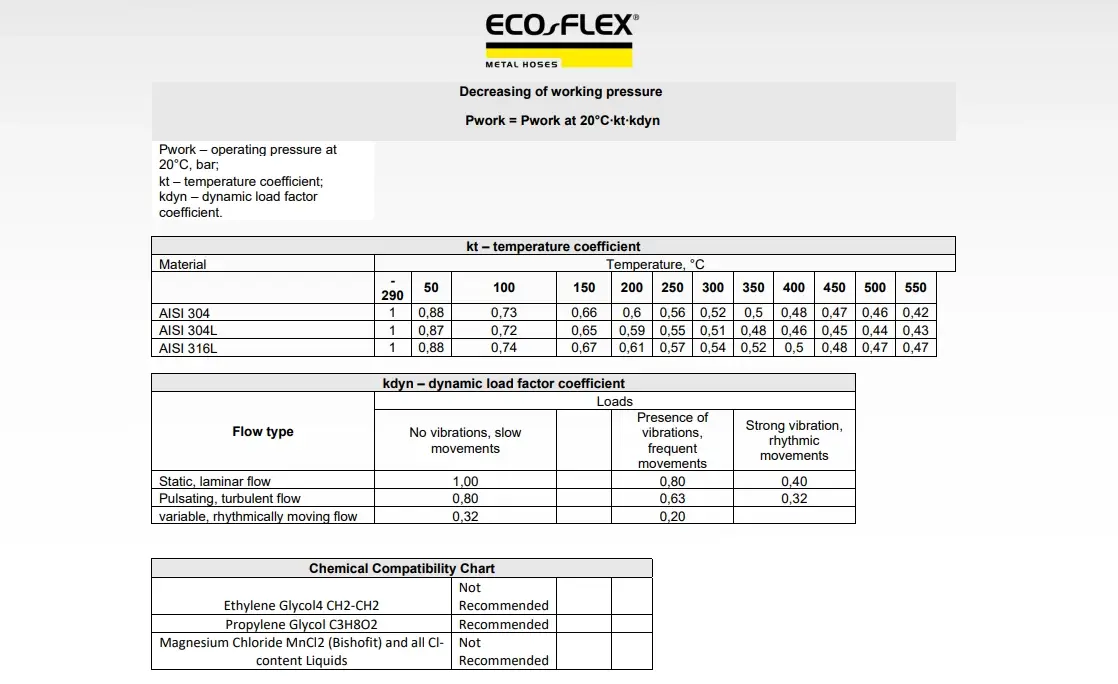
For example, at +20°C the hose can operate at 16 bar, while at +300°C the permissible pressure can be reduced by 40–50%. For Eco-Flex metal hoses the effect of temperature on the operating pressure can be determined from the table.
5. Type of working environment
Gas, water, steam, oil or aggressive chemicals have different effects on the material.
Why is it important not to exceed the operating pressure?
Exceeding this limit leads to:
- plastic deformation of the corrugated pipe;
- reduced service life;
- risk of depressurization;
- emergency situations.
Conclusion
Thus, stainless steel hoses and metal sleeves can withstand pressures ranging from a few bars in domestic systems to hundreds of bars in industrial applications. When choosing, it’s important to consider not only the maximum pressure but also the operating conditions and safety margin.
