
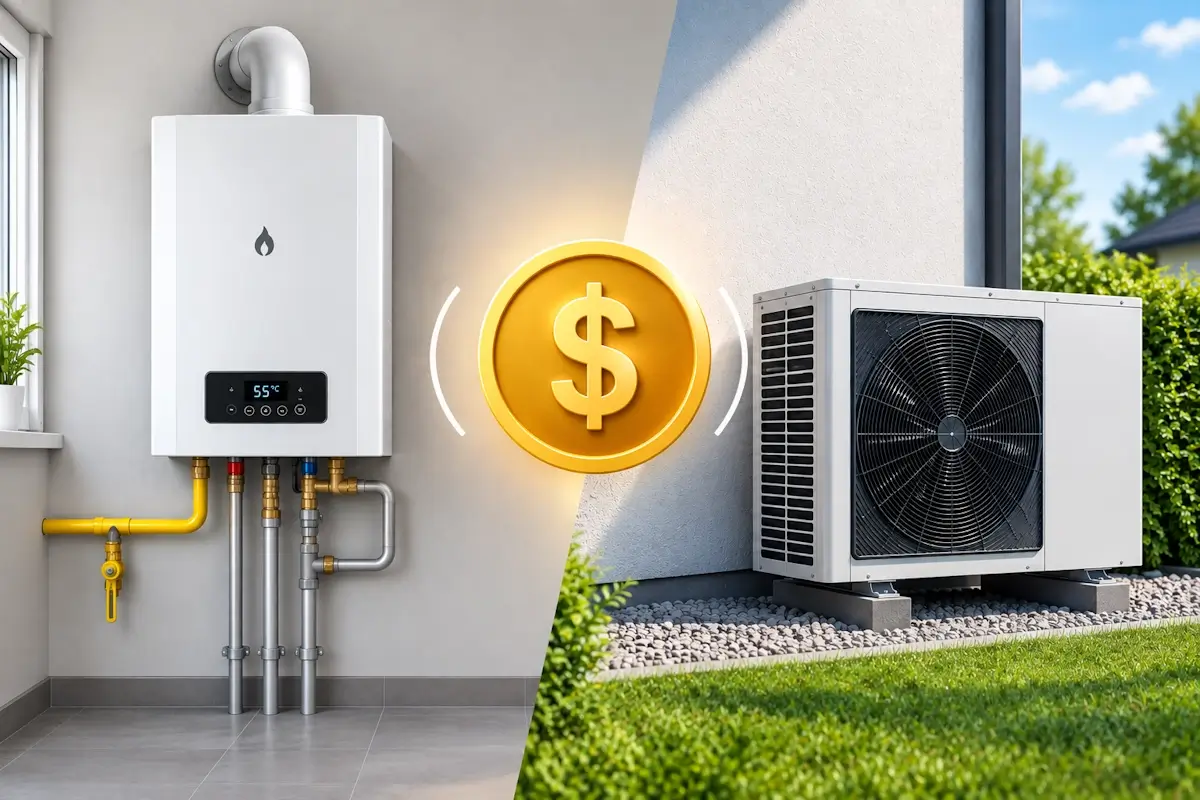
 When choosing a heating system for a private home, owners most often compare two options – a heat pump and a gas boiler. Both systems are able to provide a comfortable temperature in the premises, but the principle of their operation, initial investment and operating costs differ significantly.
What is more profitable to install today? Is a gas boiler always cheaper? And does a heat pump really allow you to significantly reduce heating costs?
In this article, we will analyze the main costs and features of both systems.
How a gas boiler works
A gas boiler uses natural gas as fuel. During its combustion, thermal energy is released, which is transferred to the coolant of the heating system.
Modern condensing gas boilers have a fairly high efficiency, especially in low-temperature operating mode. They can be used not only for heating, but also for preparing hot water.
However, the installation of gas equipment requires appropriate communications, compliance with safety requirements and the correct arrangement of the combustion product removal system.
How a heat pump works
A heat pump does not burn fuel to produce heat. It transfers thermal energy from the environment – air, soil or water – to the heating system of the house.
The most common option for private houses is an air-source heat pump. It takes heat from the outside air and transfers it to the coolant.
The pump requires electricity to operate, but it consumes less than the amount of heat energy that the system transfers to the house. This is the main economic advantage of a heat pump.
Initial costs: which is more expensive to install?
In terms of initial investment, a gas boiler usually looks more attractive.
For a gas system, you need:
- gas boiler;
- connection to the gas network;
- chimney or coaxial exhaust system;
- pipes and fittings;
- circulation equipment;
- installation and commissioning work.
A heat pump is more expensive, especially if it is a high-quality device with enough power to heat the entire house.
In addition to the heat pump itself, you may need:
- buffer tank;
- hot water storage tank;
- circulation pumps;
- automatics;
- shutoff and regulating valves;
- electrical connection;
- installation materials.
If a geothermal heat pump is used, additional work is required to arrange a ground loop or boreholes. This further increases the initial costs.
Therefore, in terms of installation cost, a gas boiler often has an advantage.
Operating costs
It is at this stage that the situation can change. A gas boiler constantly needs fuel to generate heat. The larger the area of the house and the lower the temperature outside, the more gas is needed for heating.
A heat pump consumes electricity, but its efficiency is determined by the coefficient of performance – COP. For example, if a heat pump has a COP of 4, this means that under appropriate operating conditions, using 1 kWh of electricity allows it to transfer approximately 4 kWh of thermal energy to the heating system.
However, COP is not constant. It depends on the outdoor air temperature, the temperature of the coolant and the operating mode of the equipment. In severe frost, the efficiency of the air heat pump decreases.
It is necessary to compare not only the passport indicators, but also the real seasonal energy consumption.
Example of calculation for a house of 120 m²
Let’s consider a conditional example to understand the difference between the two systems.
Let’s assume that we have an insulated house of 120 m² with a properly designed heating system. For example, let’s take an approximate need for heat energy of 15,000 kWh per heating season.
This is not a universal figure: the actual consumption of a particular house can be significantly higher or lower.
Option 1 – gas boiler
Usually, the seasonal efficiency of the system allows you to obtain approximately 0.9 kWh of useful heat from 1 kWh of gas energy. To provide 15,000 kWh of heat, you need approximately:
15 000 ÷ 0,9 = 16 667 kWh of gas energy.
If, for a simplified calculation, we assume the calorific value of natural gas to be about 9.5 kWh per 1 m³, then we get:
16 667 ÷ 9,5 ≈ 1 755 m³ gas per season.
Next, this amount needs to be multiplied by the current gas price.
Option 2 – heat pump
Now let’s assume that the average seasonal coefficient of performance of the heat pump SCOP = 3.5. Then, to produce 15,000 kWh of heat, approximately:
15 000 ÷ 3,5 ≈ 4 286 kWh of electricity.
Therefore, the annual heating costs can be roughly estimated as follows:
- Gas boiler: 1,755 m³ × gas tariff.
- Heat pump: 4,286 kWh × electricity tariff.
This example clearly demonstrates the main principle: a heat pump can transfer several times more heat energy to a house than it consumes.
But this does not mean automatic savings in all conditions. If the house is poorly insulated, the system operates with a high coolant temperature or severe frosts are often observed in winter, the actual SCOP may be lower.
How to calculate the payback of a heat pump?
Let’s assume that installing a heat pump costs a certain amount more than a gas boiler. Then, to roughly calculate the payback period, you can use the formula:
Payback period = additional installation costs ÷ annual heating savings.
For example, if a heat pump required UAH 200,000 more in initial investment, and the annual savings are UAH 40,000, the estimated payback period would be:
200 000 ÷ 40 000 = 5 years.
However, this is only a simplified calculation. In reality, it is necessary to take into account maintenance, tariff changes, winter temperatures, equipment degradation, possible operation of an electric heater and other factors.
The importance of correct system wiring
Regardless of which option is chosen, the efficiency of the system depends not only on the boiler or heat pump.
The correct connection of the equipment plays an important role. Flexible corrugated stainless steel hoses can be used for installation, which simplify the connection of individual system elements and allow you to compensate for small installation offsets.
Eco-Flex gas or water hoses can be used to connect heat pumps, heating equipment and other elements of engineering systems. The corrugated design provides flexibility, and stainless steel is well suited for use in heating systems, provided that the product is correctly selected for temperature, pressure and working environment.
At the same time, the hose should not be used as a substitute for proper pipeline design. It is important to adhere to the permissible bending radius, working pressure and temperature specified by the manufacturer.
Heat pump or gas boiler: comparison
Parameter | Heat pump | Gas boiler |
|---|---|---|
Initial cost | Higher | Lower |
Main source of energy | Electricity + environmental heat | Natural gas |
Operating costs | Can be low | Depends on gas consumption |
Working in severe frost | The effectiveness of air models is decreasing | Stable in the presence of gas |
Emissions at the operating site | No combustion products | There are combustion products |
Room cooling | Many systems can operate on cooling | Not provided |
Service | Periodic | Periodic |
Payback | Depends on operating conditions | Smaller initial budget |
When is it more profitable to install a gas boiler?
A gas boiler can be a rational choice if:
- the house is already connected to the gas network;
- there is a ready-made gas infrastructure;
- high coolant temperatures are required;
- the installation budget is limited;
- it is necessary to obtain powerful heating without significant initial investments;
- the heat pump does not provide the necessary efficiency in specific conditions.
Gas heating can be particularly logical where the gas connection is already made and the heating system is designed to work with a gas boiler.
When should you consider a heat pump?
A heat pump may be a more interesting option if:
- the house is well insulated;
- underfloor heating or another low-temperature system is used;
- there is no gasification;
- it is possible to install the necessary electrical power;
- low operating costs are important;
- not only heating, but also cooling of the premises is required;
- the owner plans to use solar panels to partially provide the system with electricity.
In this case, the higher initial cost of the heat pump can be offset by lower costs over the long term.
Which is more profitable in the long term?
There is no single answer for all homes.
If you compare only the cost of the equipment itself and installation, the gas boiler often wins. If you evaluate the system over many years of operation, you need to take into account the costs of energy carriers, maintenance, equipment replacement and the possibility of using the heat pump for cooling.
For a correct comparison, you need to determine:
heat loss of the house → required power → annual energy consumption → cost of energy carriers → maintenance costs → initial investment.
Only then can the real payback period of one option compared to the other be determined.
Conclusion
A heat pump and a gas boiler are not just two different heating devices, but different approaches to providing heat to a house.
A gas boiler usually requires a lower initial investment and is well suited for systems with traditional radiators and high coolant temperatures.
A heat pump costs more at the installation stage, but with proper design it can provide much more efficient use of electricity. It demonstrates the greatest savings potential in well-insulated houses with a low-temperature heating system.
Therefore, when choosing, you should focus not only on the price of the equipment, but on the full cost of the system over the entire service life.
And regardless of the chosen heat source, high-quality installation, correctly selected fittings and reliable connections remain an important part of the heating system. For connecting boilers, heat pumps and other elements of engineering systems, Eco-Flex offers optimal solutions based on stainless steel.
