
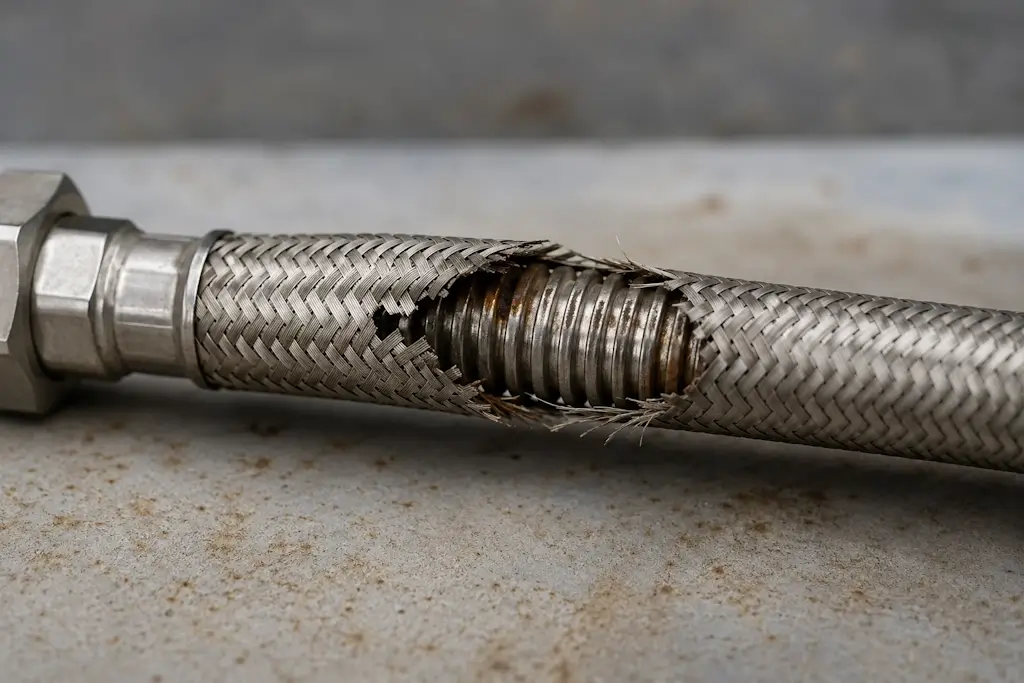
 Stainless steel metal hoses are widely used in water supply, heating, gas supply, ventilation, food, chemical and energy industries. They compensate for vibrations, thermal expansion, displacement of pipelines and ensure the sealed transportation of liquids and gases.
Despite their high strength, even a high-quality corrugated metal hose can fail due to improper installation, inappropriate operating conditions, or mechanical damage. Let’s consider the most common causes of metal hose failure and ways to prevent them.
1. Bending of the metal hose
The most common cause of damage is exceeding the minimum bending radius. When bent excessively, the corrugation deforms, local stresses arise, which over time lead to cracks or rupture of the wall.
How to avoid
- observe the minimum bending radius recommended by the manufacturer;
- do not bend the metal hose directly near the fitting or flange;
- use a hose of the appropriate length without tension.
2. Excessive stretching
The metal hose is not designed for continuous operation under axial load. If the pipeline “stretches” the sleeve, the corrugation gradually deforms, and the welds and joints work with overload.
How to avoid
- correctly calculate the installation length;
- compensate for thermal displacements with other elements of the system;
- use special compensators if significant axial displacements are expected.
3. Torsion during installation
When tightening threaded connections, sometimes the entire metal hose starts to rotate together with the nut. Such twisting creates additional mechanical loads that significantly reduce the product’s service life.
How to avoid
- use two wrenches during installation;
- do not allow the corrugated part to turn;
- after installation, make sure that the hose is not under torsional load.
4. Vibration fatigue
If the equipment is constantly vibrating, the metal gradually accumulates fatigue. This is especially true for pumps, compressors, fans, engines and industrial equipment. Signs may include small cracks in the corrugation or loss of tightness after prolonged use.
How to avoid
- do not use standard metal hoses as vibration compensators;
- install only products with braiding to compensate for vibration;
- correctly select the length and design.
5. Corrosion
Stainless steel is resistant to most environments, however, improper selection of steel grade can lead to corrosion damage. The following are particularly dangerous:
- concentrated acids;
- sea water;
- chlorides;
- aggressive chemical reagents.
How to avoid
- correctly select the material of the metal hose;
- for aggressive environments, use only AISI 316L metal hoses;
- regularly clean the equipment from aggressive deposits.
6. Operation at excessive pressure
Each metal hose has a maximum working and test pressure. Constant operation exceeding the permissible parameters significantly accelerates the destruction of the corrugation.
How to avoid
- correctly select the product according to the operating pressure;
- install reducers or safety valves;
- consider possible water hammer.
7. Temperature overload
When the permissible temperature is exceeded, the metal loses its mechanical strength, and the seals may age faster.
How to avoid
- use metal hoses designed for the required temperature regime;
- consider not only the operating, but also the peak temperature of the system.
8. Mechanical damage
During installation or operation, the metal hose may receive:
- impacts;
- dents;
- scratches;
- damage to the braid;
- abrasion against other structural elements.
Even minor damage can become a place of stress concentration.
How to avoid
- avoid impacts on the metal hose;
- use protective covers if necessary;
- avoid contact with sharp edges.
9. Wrong choice of metal hose
Quite often, problems arise at the design stage. For example:
- insufficient diameter;
- incorrect type of connection;
- lack of braiding at high pressure;
- using a standard metal hose in an aggressive environment.
How to avoid
Before purchasing, you must consider:
- working pressure;
- temperature;
- type of working environment;
- allowable bending radius;
- necessary compensation for displacements;
- presence of vibrations;
- installation conditions.
Regular inspection extends service life
Even high-quality metal hose is recommended to be checked periodically. Pay attention to:
- deformation of the corrugation;
- damage to the braid;
- traces of corrosion;
- leaks;
- loosening of threaded or flanged connections;
- abrasion and mechanical damage.
Timely replacement of the product is much cheaper than emergency repair of the pipeline.
Conclusion
Most damage to metal hoses is not associated with the quality of the product, but with violation of installation rules, incorrect selection or non-compliance with operating conditions. Compliance with the manufacturer’s recommendations, correct calculation of operating parameters and regular technical inspection can significantly extend the service life of the metal hose and ensure safe and uninterrupted operation of the system.
For critical systems, it is worth choosing stainless steel metal hoses made of high-quality materials that meet the requirements for operating pressure, temperature and chemical resistance. This minimizes the risk of premature failure and will ensure reliable operation for many years.
