
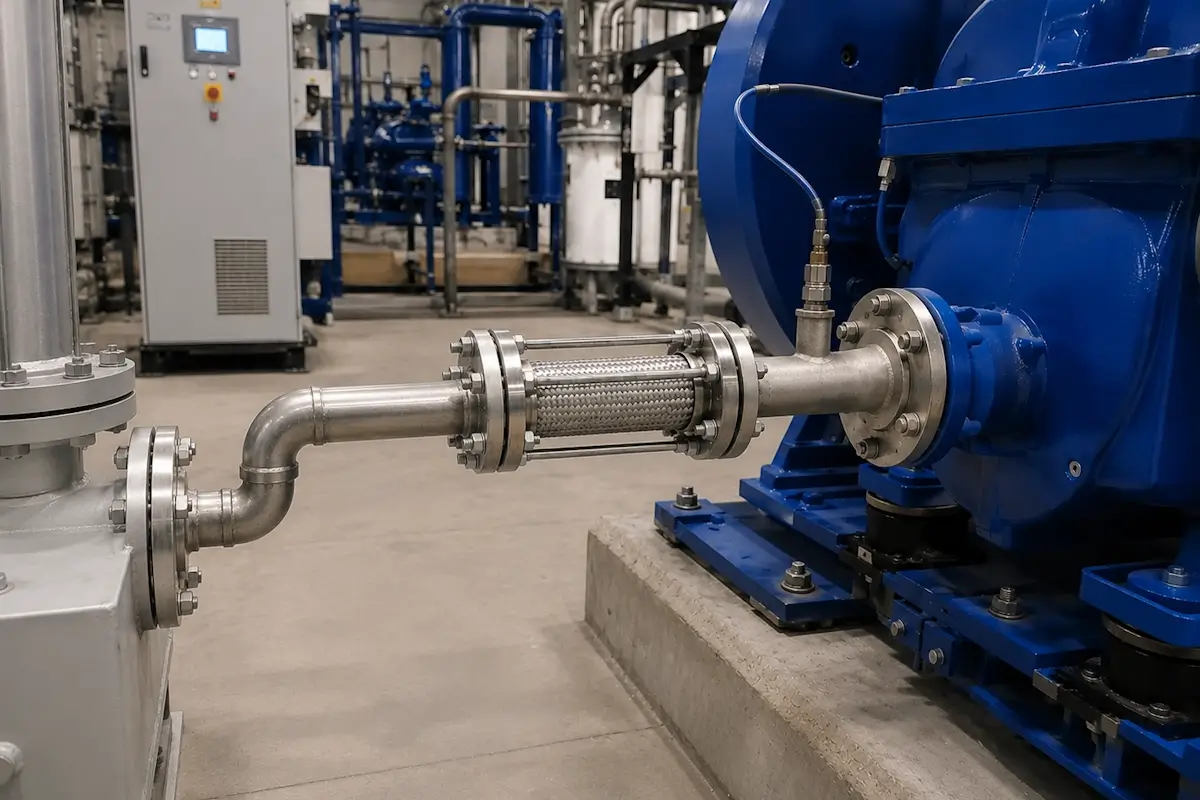
 In industrial, domestic and commercial systems, vibrations occur almost always: during the operation of pumps, boilers, compressors, generators, ventilation equipment, heat pumps. A vibration damper is an element of a piping system that compensates for vibrations, oscillations and mechanical loads that occur during the operation of the equipment. Without compensation, such oscillations can lead to:
- loosening of threaded connections;
- appearance of leaks;
- noise and hum in the system;
- premature wear of pipes and equipment;
- damage to equipment, appearance of microcracks.
That is why vibration dampers are an important element of the safe and durable operation of engineering systems.
How does a vibration damper work?
The principle of operation of a vibration damper is to absorb and compensate for mechanical vibrations. The flexible design allows the element to deform within permissible values and not transfer the load further through the system. Particularly effective vibration dampers are corrugated stainless steel hoses, which combine:
- flexibility;
- strength;
- pressure resistance;
- durability;
- temperature resistance.
Due to the corrugated structure and elasticity of the metal hose, such hoses work perfectly as compact vibration compensators.
Design of vibration dampers based on corrugated stainless steel metal hose
The design of vibration dampers usually includes:
- thin-walled corrugated hose;
- outer braid of stainless steel wire;
- connecting pipes or fittings.
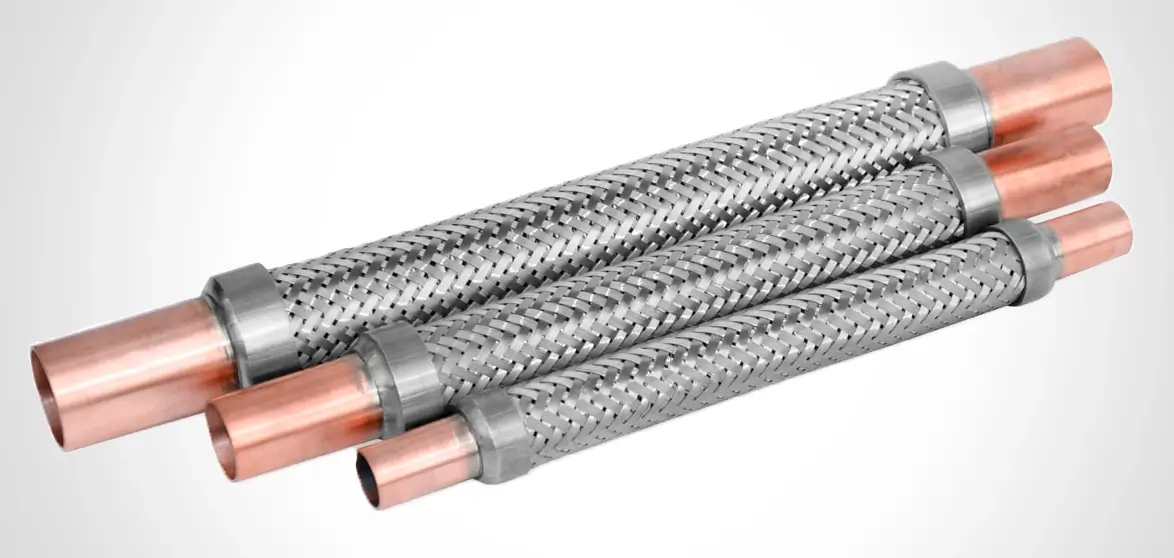
Corrugated metal hose
The corrugated part provides:
- high flexibility;
- effective vibration compensation;
- resistance to cyclic loads and pressure drops.
Corrosion-resistant grades of stainless steel are used to manufacture corrugated hoses:
- AISI 304;
- AISI 316L.
Thin-walled corrugation effectively absorbs vibrations and oscillations, reducing load transfer to the pipeline, equipment and system connections.
External braiding
The external braiding performs several important functions at once:
- limits axial stretching of the metal hose;
- increases permissible operating pressure;
- protects the corrugation from mechanical overloads and damage.
The quality and density of the braid directly depend on:
- product durability;
- resistance to pulsations and vibrations;
- stable operation under high pressure and intensive loads.
Where are vibration dampers used?
Gas systems
One of the most common applications is the connection of gas equipment, such as boilers or industrial gas installations. During operation, gas equipment creates microvibrations that can be transmitted to the pipeline. Using flexible stainless steel gas hoses helps to compensate for these loads and reduce the risk of damage to the connections. That is why gas hoses are often used not only as connecting elements, but also as effective vibration dampers. Among our range, the Eco‑Flex EN14800 gas hose copes best with vibration damping.
Pumping equipment
Pumps create constant vibrations during operation. Without compensation, vibration is transmitted to pipes, fasteners and fittings. Flexible pump inserts help to:
- reduce noise;
- compensate for vibration;
- reduce the load on the fittings;
- extend the system life.
Heating systems and heat pumps
Modern heating systems often use circulation pumps, compressors and other equipment that creates vibration. The use of vibration dampers allows
- compensate for thermal expansion;
- reduce mechanical loads;
- simplify installation in confined spaces.
Generators and Compressors
Diesel and gasoline generators create significant vibrations. Rigid piping connections in such systems often lead to:
- cracking;
- leakage
- damage to joints.
Vibration mounts based on flexible stainless steel metal hoses effectively absorb vibrations and ensure a reliable connection even in difficult operating conditions.
Important recommendations when using hoses as vibration dampers
For the hose to work effectively as a vibration damper, it is important to:
- do not allow excessive tension;
- avoid sharp bends;
- choose the correct length;
- consider the operating pressure and temperature;
- use certified hoses for gas and technical media.
It is also important to install a hose with a small margin of flexibility – this allows it to better compensate for vibrations.
Conclusion
Vibration dampers are an important part of modern engineering systems. They help reduce noise, protect pipelines from damage and extend the life of equipment. Stainless steel vibration dampers can work in gas supply systems, heating, pumping equipment, generators and other engineering networks. Due to the combination of flexibility, strength and durability, they ensure reliable and safe operation of systems even in conditions of constant vibrations.
