
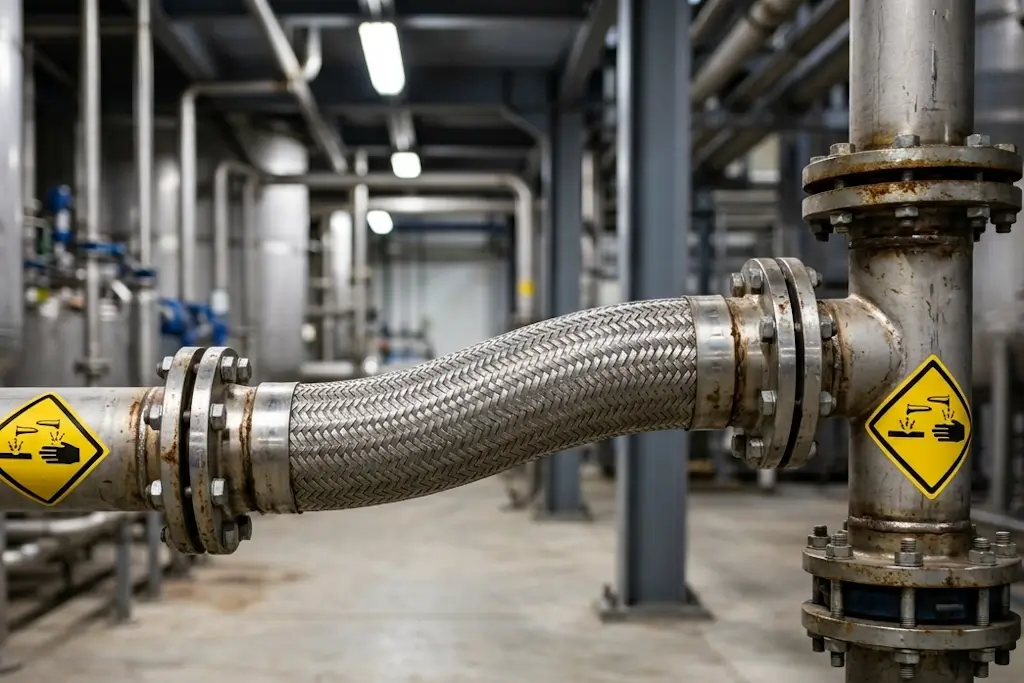
 In many industrial enterprises, metal hoses operate in difficult conditions: they come into contact with acids, alkalis, solvents, sea water, hot steam or other chemically active substances. In such cases, a mistake in choosing a metal hose can lead to rapid corrosion, loss of tightness, emergency shutdown of equipment and significant financial losses.
In this article, we will consider what characteristics you should pay attention to when choosing metal hose for aggressive environments.
What is considered an aggressive environment?
Aggressive is an environment that can cause corrosion or destruction of metal. Such substances include:
- acids of various concentrations;
- alkali;
- salt solutions;
- sea water;
- organic solvents;
- petroleum products;
- hot process fluids;
- superheated steam;
- gases with high corrosive activity.
Each environment has its own level of impact on metal, so there is no universal solution.
In which industries are metal hoses used for aggressive environments?
Such metal hoses are widely used in:
- chemical industry;
- petrochemistry;
- pharmaceutical production;
- food industry;
- energy industry;
- shipbuilding;
- fertilizer production;
- gas industry;
- water purification systems.
Metal hose material is the main selection criterion
The most important parameter is the stainless steel grade. For work in aggressive environments, AISI 304 and AISI 316L grades are most suitable.
AISI 304
This is the most common stainless steel. It has good mechanical strength, resistance to most household environments, and is affordable. However, it is also characterized by insufficient resistance to chlorides and concentrated acids.
Most often, AISI 304 metal hoses are used for work in heating and ventilation systems. They allow the transport of water, air, and most inert gases.
AISI 316L
The optimal option for most aggressive environments. Due to the molybdenum content, this steel has significantly higher corrosion resistance.
Advantages of AISI 316L metal hoses:
- Resistance to sea water;
- High resistance to chlorides;
- Good compatibility with many acids;
- Long service life.
Such metal hoses can be used in:
- food industry;
- chemical industry;
- pharmaceuticals;
- heat exchange equipment;
- marine installations.
The influence of operating temperature
The chemical resistance of metal is strongly dependent on temperature. For example, at a temperature of 20 °C, acid may have practically no effect on the metal, while at 100–150 °C the corrosion rate may increase tenfold. Therefore, when choosing a metal hose, it is always necessary to consider:
- maximum ambient temperature;
- possible temperature peaks;
- cyclic heating and cooling.
If you plan to work in high temperature conditions, then you should use metal hoses made of AISI 321 steel, which operates at temperatures up to 800 °C. Such operating conditions can be in exhaust systems, high-temperature pipelines, furnaces, boiler equipment.
Connection type
It is equally important to choose the right end connections. The material of the connecting elements must match the environment and the material of the metal hose.
Additional protection
In some cases, stainless steel metal hoses may require an additional protective layer. The most common are:
- polymer protective coating;
- PVC sheath;
- silicone insulation;
- ultraviolet protection;
- thermal insulation;
- stainless steel wire braiding.
Such solutions are especially relevant for work outdoors or in contact with particularly aggressive reagents. Without the use of a protective layer, a metal hose can fail after just a few months of operation.
Conclusion
Choosing a metal hose for aggressive environments requires a comprehensive approach. It is necessary to take into account the chemical composition of the environment, temperature, operating pressure, type of connection and operating conditions. A properly selected metal hose will ensure reliable operation of the equipment, minimize the risk of accidents and significantly increase the service life of the pipeline system.
Eco-Flex specialists will help you to choose a metal hose according to your operating conditions and technical requirements to ensure reliable and long-lasting operation of the equipment.
