
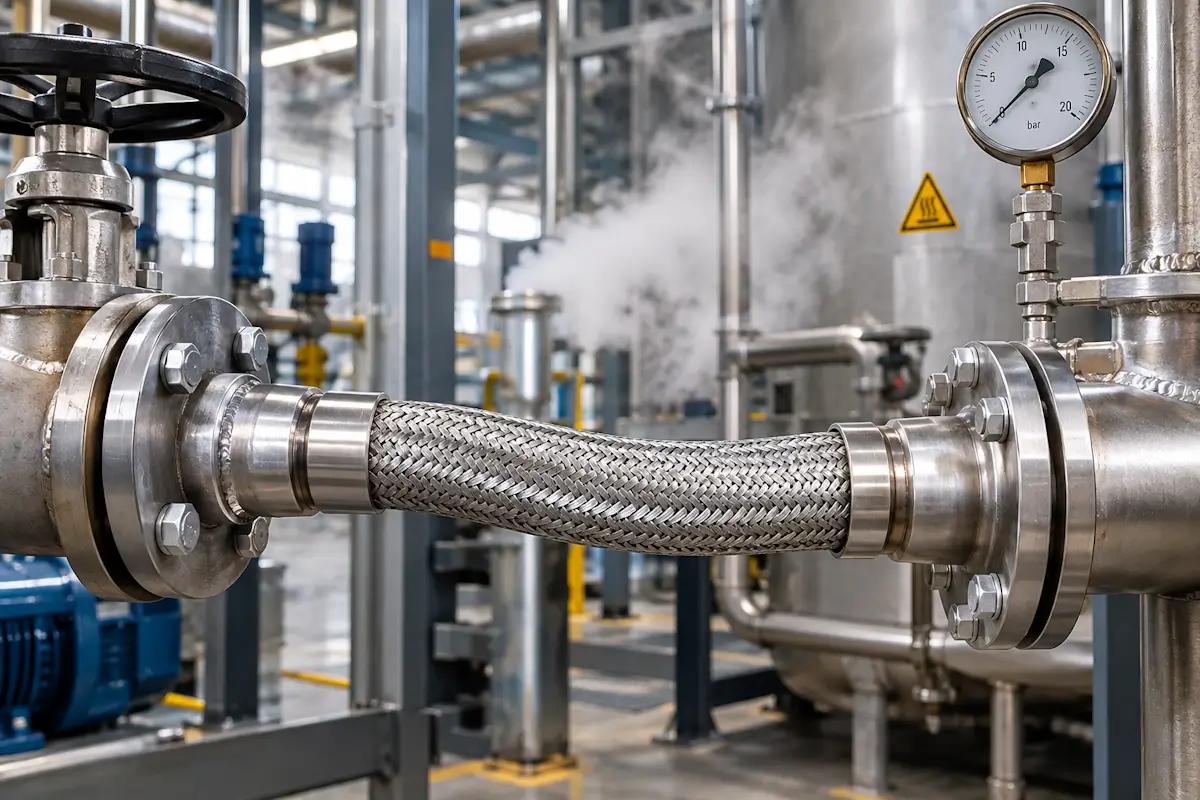
 Steam systems are used in industry, energy production, food manufacturing, chemical plants, and engineering utilities. When installing such systems, it is necessary to consider not only the high temperature of the working medium, but also pressure, thermal expansion of pipelines, vibrations, and mechanical loads.
Flexible metal hoses for steam can be used to connect equipment and compensate for pipeline movements. Thanks to their metal construction, they can operate in conditions where conventional elastomer hoses may have limitations.
What Should a Metal Hose for Steam Be Like?
Metal hose is a flexible pipeline made of metal, most commonly stainless steel. The main element of its construction is a corrugated metal tube, which provides the required flexibility.
Depending on its application, a metal hose may be equipped with:
- stainless steel braid;
- welded or threaded connection elements;
- flanges;
- fittings;
- other types of connections.
The braid performs an important function — it limits deformation of the corrugated tube under internal pressure and increases the mechanical strength of the construction.
When selecting a metal hose for steam, it is necessary to consider not only its diameter, but also the operating pressure, temperature, material, and type of connections.
Why Are Metal Hoses Used for Steam?
Steam is characterized by a high temperature and, depending on the system, significant operating pressure. In addition, pipelines change their length when heated.
A rigid connection between equipment and a pipeline under such conditions can create additional mechanical loads. A flexible metal hose allows some of the movements and vibrations to be compensated for.
The main advantages of metal hoses in steam systems include:
- resistance to high temperatures;
- mechanical strength;
- flexibility;
- ability to compensate for minor movements;
- stainless steel corrosion resistance;
- possibility of manufacturing with different types of connections;
- long service life when properly selected and installed.
Temperature and Pressure — Key Selection Parameters
When working with steam, particular attention should be paid to two parameters — temperature and pressure.
It is not sufficient to consider only the maximum temperature specified for a metal hose. The permissible parameters depend on the specific construction of the product and may change depending on temperature.
As temperature increases, the properties of the materials and construction may change, so the operating parameters of the metal hose must be determined according to the manufacturer’s technical documentation.
For example, if a metal hose is rated for a certain pressure at room temperature, this does not mean that it can be used at the same pressure at a high steam temperature.
Before installation, it is necessary to check the permissible operating pressure and temperature values specifically for the particular metal hose model.
The Construction of the Metal Hose Is Also Important
Metal hoses with different constructions can be used in steam systems. The corrugated tube and braid are important components.
The corrugated tube provides flexibility, while the metal braid absorbs a significant portion of the load generated by internal pressure.
The material of the metal hose is also important. Stainless steel products can be manufactured from different steel grades, including AISI 304 or AISI 316L. The choice of material depends on the temperature, working medium, and operating conditions.
If the steam comes into contact with other substances or the system operates in an aggressive environment, the material must be selected with consideration of the specific operating conditions.
How to Properly Install a Metal Hose for Steam?
Even a high-quality metal hose can fail quickly if it is installed incorrectly.
Several basic rules should be followed during installation.
- Avoid twisting. The metal hose must operate in the deformation direction specified by the manufacturer. Twisting around its own axis creates additional loads on the corrugated tube and braid.
- Do not use the metal hose as a replacement for a pipeline. A flexible hose should not compensate for installation errors in the entire system. It must be installed according to its intended purpose and permissible bending radii.
- Observe the minimum bending radius. Excessive bending can damage the corrugated tube or braid. The minimum bending radius depends on the construction, diameter, and installation method.
- Avoid axial stretching. The metal hose should not constantly operate under excessive tensile loads. To compensate for thermal movements, its length and installation configuration must be properly calculated.
- Properly support the pipeline. Pipeline supports and fasteners must be positioned so that the weight of the pipes and equipment is not transferred directly to the metal hose.
Metal Hose as a Compensator for Thermal Expansion
One practical application of flexible metal hoses in steam systems is compensating for movements that occur when the pipeline is heated and cooled.
When the pipeline temperature changes, the metal expands or contracts. If the pipeline is rigidly connected to equipment, this can create additional loads on nozzles and connections.
A flexible metal hose can partially compensate for such movements, reducing mechanical loads on the equipment.
At the same time, it is important to understand that not every metal hose can be used as a full-fledged thermal expansion compensator. Its capabilities depend on its construction, length, number of cycles, direction of movement, and other parameters.
Metal Hose Compensates for Vibrations and Pulsations
Steam installations may be connected to pumps, valves, heat exchangers, and other equipment. Such components can generate vibrations and pulsations.
A flexible metal hose can reduce the transmission of some mechanical vibrations between the pipeline and equipment.
This is particularly relevant at equipment connection points where it is undesirable to transmit vibration to a rigid pipeline.
Condensate in a Steam System
Special attention should be paid to condensate. When steam cools, water is formed, which can accumulate in certain sections of the system.
Therefore, proper condensate drainage must be provided when designing and installing steam pipelines.
The metal hose should not be installed in such a way that an unwanted loop or condensate accumulation point is continuously formed inside it, unless this is предусмотрed by the system design.
Inspection and Maintenance of Metal Hoses for Steam
During operation of a steam system, the metal hose must be inspected periodically.
Particular attention should be paid to:
- the condition of the corrugated tube;
- the condition of the metal braid;
- connection points;
- the presence of deformations;
- signs of corrosion;
- mechanical damage;
- signs of overheating;
- leaks or loss of tightness.
If cracks, significant deformations, braid damage, or other signs of failure appear on the metal hose, it must be replaced.
Do not attempt to restore a damaged corrugated section by mechanical straightening or welding without the appropriate technology and an assessment of the product’s suitability.
Typical Operating Mistakes
Common mistakes include:
- Using a metal hose without a safety margin for operating parameters. Continuous operation at the limit values of temperature and pressure is undesirable. Selection should be based on the actual operating conditions.
- Incorrect installation. Twisting, excessive bending, or improper fastening can significantly reduce the service life of the product.
- Incorrect length selection. A metal hose that is too short may operate under excessive mechanical loads, while excessive length can create unwanted sagging and loops.
- Ignoring temperature. When selecting a metal hose, it is not possible to consider pressure alone. For steam, temperature is one of the key parameters.
- Lack of regular inspection. Even metal products resistant to high temperatures require periodic inspection.
How to Choose a Metal Hose for Steam?
Before ordering a metal hose, it is necessary to determine:
- The type of working medium — saturated or superheated steam.
- Operating temperature.
- Operating and possible maximum pressure.
- Required internal diameter.
- Metal hose length.
- The type of movements it must compensate for.
- The number of bending cycles if the hose will operate dynamically.
- Metal hose material.
- Type of connection elements.
- Installation conditions and available space.
For complex systems, selection should preferably be based on the technical parameters of the specific equipment and the recommendations of the metal hose manufacturer.
Conclusion
Flexible metal hoses for steam can be used to connect equipment, compensate for pipeline movements, and reduce the transmission of vibrations. Stainless steel provides the required resistance to high temperatures, while the corrugated construction provides flexibility.
However, safe and long-lasting operation depends not only on the material. The metal hose must be properly selected according to temperature, pressure, diameter, length, and type of loads, and installation requirements must also be followed.
For steam systems, it is particularly important to use products whose specifications are confirmed by the manufacturer’s technical documentation and correspond to the actual operating conditions.
