
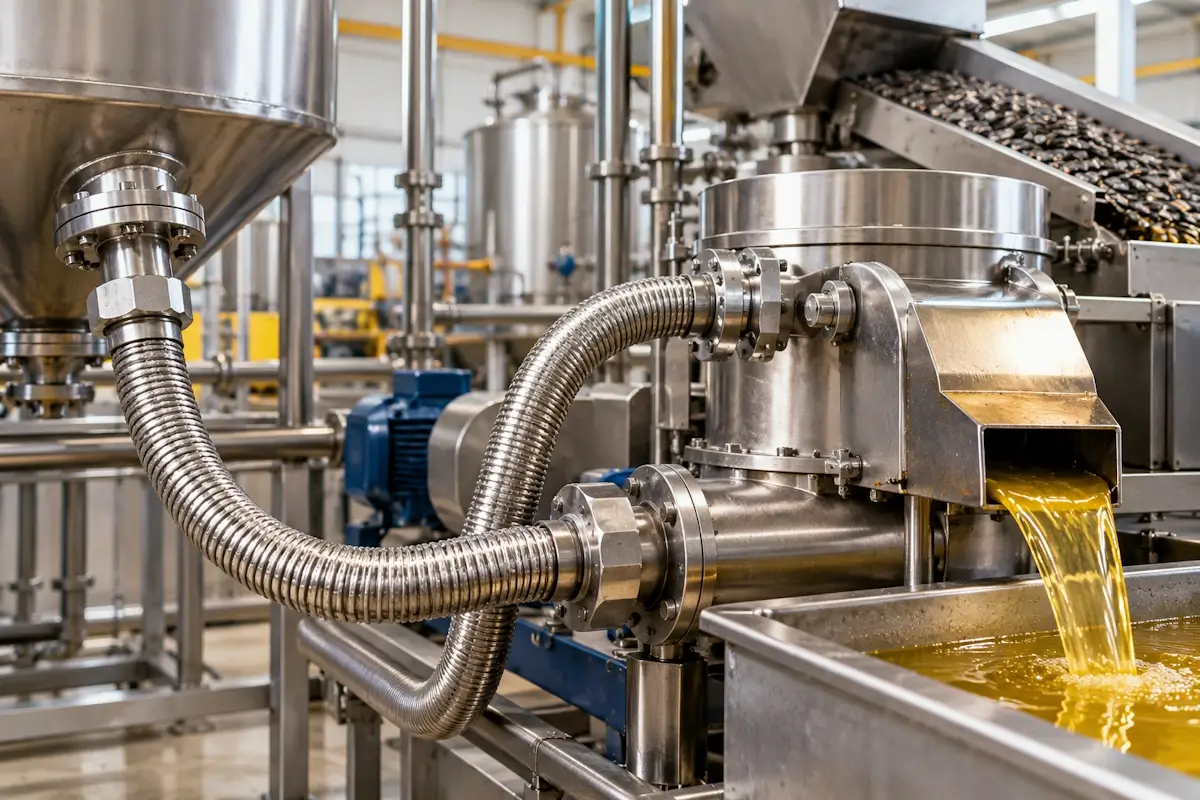
 Transporting vegetable oils is an important part of many technological processes in the food processing industry. Oil is transferred between storage tanks, pumps, filters, heat exchangers, filling lines, and other processing equipment. The piping system must ensure leak-tightness, a stable product flow, and compliance with requirements for materials that come into contact with food products.
Stainless steel flexible metal hoses can be used in such systems. Thanks to their flexible corrugated construction, they can compensate for vibration, minor equipment movements, and installation misalignments while simplifying the connection of individual components in a process line. Stainless steel is also widely used in food processing applications, which is why stainless steel hoses and metal hoses are used in the food industry for transporting various liquid and bulk products.
Why Use a Metal Hose for Oil Transfer?
Vegetable oils can be transported at different temperatures and pressures, while pumps and other process equipment generate vibration during operation. Rigid piping systems cannot always compensate for these mechanical loads and movements.
A corrugated stainless steel metal hose combines the flexibility of a hose with the strength of a metal construction. It can be used for connecting pumps, storage tanks, heat exchangers, filters, and other industrial equipment in oil processing and food production systems.
The main advantages of using a stainless steel metal hose for oil transfer include:
- flexibility during installation;
- vibration compensation;
- compensation for minor installation misalignments;
- resistance to temperature fluctuations;
- high mechanical strength;
- leak-tight connections when the appropriate fittings are selected;
- corrosion resistance of stainless steel.
Which Stainless Steel Is Suitable for Vegetable Oil?
One of the most important factors when choosing a metal hose for oil transfer is the material used for the hose’s wetted parts. Stainless steel grades such as AISI 304 are widely used in food processing equipment and piping systems. For more demanding operating conditions, AISI 316L stainless steel may be used due to its enhanced resistance to corrosive environments.
Choosing the right stainless steel grade depends on the composition of the oil or other product being transported, operating temperature, cleaning conditions, and other parameters of the technological process.
When selecting a metal hose for oil transfer, it is important to consider not only the stainless steel grade of the hose but also the materials of all components that come into contact with the oil, including fittings, connectors, gaskets, and other components.
Features of Hot Vegetable Oil Transfer
In food processing facilities, vegetable oil may be transported at elevated temperatures rather than at room temperature. Heating can be used to reduce the viscosity of the oil and maintain the required flow rate and efficiency of the production process.
Higher operating temperatures affect the selection of a stainless steel flexible hose. The following parameters should therefore be considered:
- maximum operating temperature;
- operating pressure;
- number of temperature cycles;
- corrugation design;
- presence of a stainless steel braid;
- sealing material;
- type and specifications of connecting fittings;
- cleaning method used for the process piping system.
A metal hose should not be selected based on diameter alone. Its specifications must correspond to the pressure, temperature, medium, connection type, installation conditions, and other operating parameters of the specific system.
As a manufacturer of industrial metal hoses, Eco-Flex offers stainless steel hoses and metal hose assemblies designed for applications in the food processing and chemical industries and suitable for a wide range of operating temperatures.
Can One Metal Hose Be Used for Different Types of Oil?
Not necessarily. If a metal hose is installed in a process line used to transport different products, cleaning requirements and the risk of cross-contamination must be taken into account.
Stainless steel can be a suitable material for contact with food products, but the complete hose assembly and the entire piping system must meet the requirements of the specific application. Particular attention should be paid to gaskets, seals, and other non-metallic components.
For food-grade hoses, manufacturers may specify compatibility with vegetable oils, animal fats, and other food products, as well as recommended cleaning procedures and operating temperature limits.
Where Can a Metal Hose for Oil Transfer Be Used?
Corrugated stainless steel metal hoses can be used in different sections of an oil processing or food production line:
- for connecting pumps;
- between storage tanks and pumping equipment;
- for connecting filters;
- in oil supply systems for process equipment;
- for connecting heat exchangers;
- in areas where vibration compensation is required;
- in locations where rigid piping is difficult to install;
- to compensate for minor thermal expansion and installation movements.
A metal hose can therefore serve not only as a flexible connection but also help reduce mechanical loads transmitted to pumps, tanks, heat exchangers, and other process equipment.
Conclusion
Stainless steel metal hoses for oil transfer are a practical solution for creating flexible connections in industrial process piping systems. When correctly selected and installed, they can be used for connecting pumps, storage tanks, filters, heat exchangers, and other equipment used in food processing and oil handling applications.
When choosing a metal hose for vegetable oil, it is important to consider more than just the hose diameter. Key parameters include the material, operating pressure, temperature, hose length, minimum bend radius, connection type, sealing material, cleaning method, and the properties of the transported product.
For food processing applications, it is particularly important that all components coming into contact with the oil are suitable for the specific product and comply with the requirements of the relevant technological process.
