
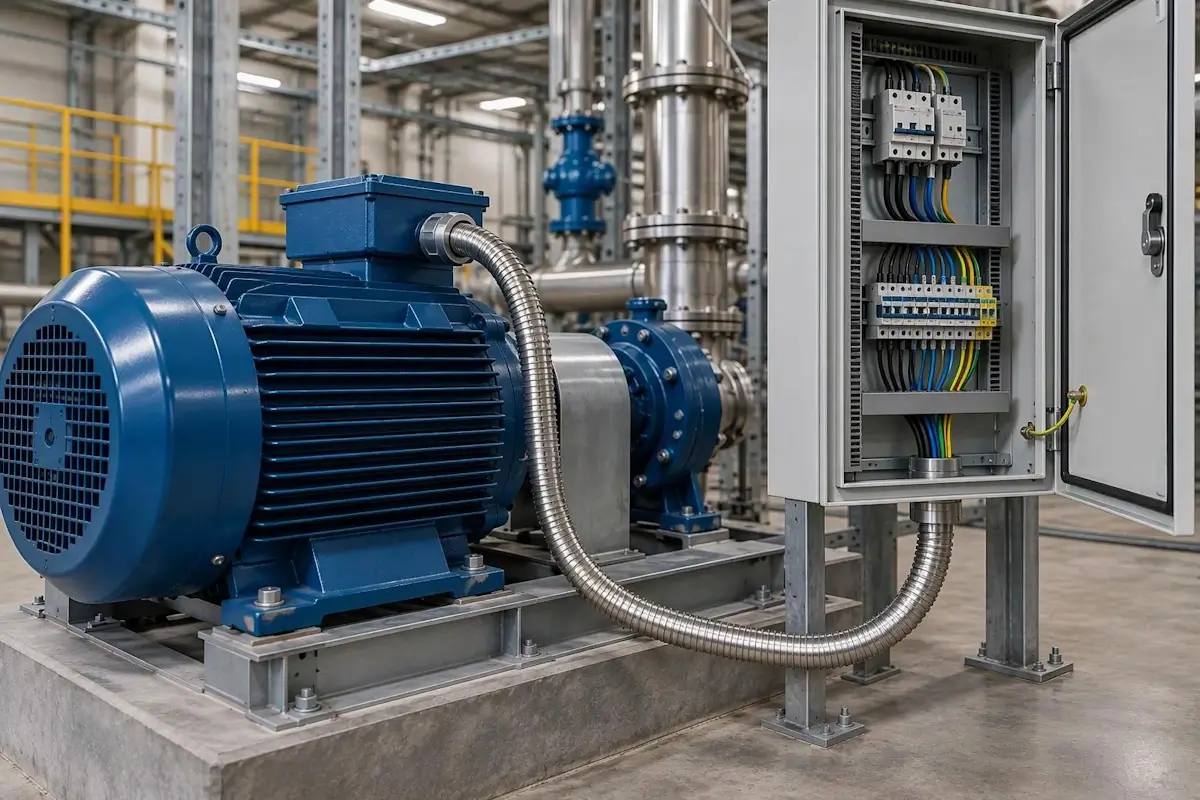
 Electrical cables are an important component of any industrial, commercial, and residential infrastructure. They supply power to equipment, automation systems, lighting, and instrumentation. However, during operation, cable runs are often exposed to mechanical loads, moisture, dust, aggressive substances, and temperature fluctuations. Special protective enclosures are used to reduce the risk of insulation damage and extend the service life of electrical wiring.
One reliable solution is a corrugated stainless steel flexible conduit. Thanks to its design and material properties, it provides additional mechanical protection for cables and makes it possible to route electrical services in conditions where conventional plastic corrugated conduits may not be sufficiently effective.
Why Are Flexible Metal Conduits Used to Protect Cables?
A flexible metal conduit is a flexible tubular product made from metal strip or corrugated stainless steel. Its design provides flexibility, allowing it to follow the route of a cable run and be used in areas with complex layouts.
The primary purpose of a flexible metal conduit for cables is to create an additional barrier between the electrical conductor and the external environment.
The protective sheath helps prevent:
- mechanical damage to cable insulation during installation and operation;
- cable damage caused by contact with sharp edges of metal structures;
- the adverse effects of dust and industrial contaminants;
- damage to cable runs in areas with high humidity, provided that the appropriate design and sealed connections are used;
- premature cable wear caused by vibration and equipment movement.
The use of flexible metal conduits is particularly relevant in manufacturing plants, mechanical engineering, the energy sector, the food industry, and other fields where electrical systems must meet higher reliability requirements.
Types of Flexible Metal Conduits for Cable Protection
By design and manufacturing method, stainless steel flexible metal conduits can be broadly divided into two main types: sealed and non-sealed.
- Sealed flexible metal conduit is made from metal strip whose edges are joined by welding along a longitudinal seam. This design makes the metal sheath itself airtight and provides additional protection against the ingress of dust, moisture, and other external contaminants when suitable end connections are used. To ensure that the entire cable system is fully protected against water or dust, sealed end fittings and proper installation are also required.
- Non-sealed flexible metal conduit has a spiral construction formed by winding metal strip without welding the seam. This type of conduit provides mechanical protection, flexibility, and resistance to external damage, but it is not waterproof. The choice between these two types depends on the operating conditions of the cable run and the required level of protection.
Advantages of Corrugated Flexible Metal Conduits for Electrical Wiring Protection
Stainless steel has a number of properties that make it a suitable material for manufacturing protective sheaths for cable runs.
- Mechanical strength. The metal construction creates a physical barrier that protects the cable from accidental impacts, abrasion, and contact with other equipment components. This is particularly important when wiring is routed near moving mechanisms, metal structures, and industrial machinery.
- Corrosion resistance. Stainless steel offers enhanced resistance to corrosion. This makes flexible metal conduits suitable for use in high-humidity premises and in environments where contact with water and certain chemicals may occur. However, resistance to a particular environment depends on the steel grade and operating conditions.
- Flexibility and ease of installation. The corrugated design allows the flexible metal conduit to be bent and routed along complex surfaces, around obstacles, and to equipment located in different planes. This simplifies the installation of cable routes and can reduce the number of additional connections required.
- Resistance to temperature effects. Stainless steel retains its mechanical properties across a wide temperature range. Therefore, flexible metal conduits can be used near equipment that heats up during operation. At the same time, the permissible operating temperature of the entire cable system also depends on the properties of the cable itself, its insulation, and the connecting components.
- Long service life. Thanks to its corrosion resistance and ability to withstand mechanical loads, a high-quality stainless steel flexible metal conduit can perform its protective function for a long time. This helps reduce the frequency of repairs and replacement of damaged sections of cable runs.
Where Are Flexible Metal Conduits Used for Cable Runs?
Protective flexible metal conduits are used in various industries where reliable operation of electrical systems is essential.
- Industrial equipment. Flexible metal conduits protect cables used to connect electric motors, pumps, compressors, machine tools, and other units. Their use is particularly relevant in areas subject to high vibration and where wiring is at risk of mechanical damage.
- Food industry. In production facilities, cable runs may come into contact with moisture, cleaning solutions, and process contaminants. Stainless steel is suitable for such conditions, provided that the material grade and flexible metal conduit design are selected correctly.
- Power engineering and electrical installations. Flexible metal conduits are used to provide additional protection for power cables, control wires, and connection lines for electrical equipment.
- Automation systems. Cables for sensors, controllers, and measuring instruments are often routed near moving mechanisms. A flexible metal conduit helps protect them from abrasion and mechanical damage.
- Ventilation and pumping units. Vibration occurs while this equipment is operating and can adversely affect cable connections. Flexible metal conduits provide additional wiring protection at connection points.
How to Choose the Right Flexible Metal Conduit for Cable Protection
To ensure that a flexible metal conduit performs its function effectively, several factors must be considered when selecting one.
- Flexible metal conduit diameter. The internal diameter must correspond to the number and outside diameter of the cables. It is important to leave enough space for them to be routed freely to avoid excessive compression and damage to the insulation.
- Stainless steel grade. Various steel grades can be used to manufacture flexible metal conduits, including AISI 304 and AISI 316L. The choice depends on the operating conditions, humidity level, and presence of aggressive chemicals.
- Construction type. Different flexible metal conduit designs are used depending on the application. Products with an additional external braid may be used in areas subject to intense vibration or increased mechanical loads.
- Installation method. Where necessary, various connecting components are used to connect the flexible metal conduit securely. These provide reliable fastening or the required level of sealing.
Installation Considerations for Cable Flexible Metal Conduits
Even a high-quality flexible metal conduit will not provide adequate protection if certain installation recommendations are not followed. It is important to:
- determine the optimal conduit length and cable route before laying the cables;
- avoid excessively small bend radii, which may damage both the flexible metal conduit itself and the cable insulation inside it;
- use a flexible metal conduit of the appropriate diameter;
- avoid excessive tension or compression of the sheath;
- use fittings compatible with the flexible metal conduit;
- securely fasten the protective sheath near equipment connection points;
- allow for the maintenance and replacement of electrical wiring;
- comply with electrical safety requirements and regulations governing cable installation.
Particular attention must be paid to electrical safety. The use of a metal conduit does not, in itself, mean that it automatically provides grounding or protection against electric shock. If the construction is used as part of a protective earthing or equipotential bonding system, appropriate electrical connections must be provided and their continuity must be checked.
Why Choose Stainless Steel Flexible Metal Conduits?
Standard plastic corrugated conduits are suitable for many typical electrical wiring installation conditions. However, in industrial premises, on production lines, and near equipment exposed to elevated temperatures or vibration, their performance may be insufficient.
Stainless steel flexible metal conduits provide a durable protective sheath with corrosion resistance, combining mechanical reliability with flexibility. This makes them suitable for protecting cables in demanding operating conditions where long service life and stable operation of electrical systems are essential.
At the same time, the selection process must take into account not only the material but also the design of the flexible metal conduit, the characteristics of the connecting components, and the requirements of the specific facility.
Conclusion
Protecting cables with stainless steel flexible metal conduits is an effective way to reduce the risk of mechanical damage and the impact of adverse external factors on electrical systems. These products combine flexibility, corrosion resistance, and mechanical strength, making them suitable for industrial facilities, the energy sector, food production, and automated systems.
A correctly selected flexible metal conduit helps improve the reliability of cable runs, simplify installation, and reduce equipment maintenance costs throughout its service life.
