
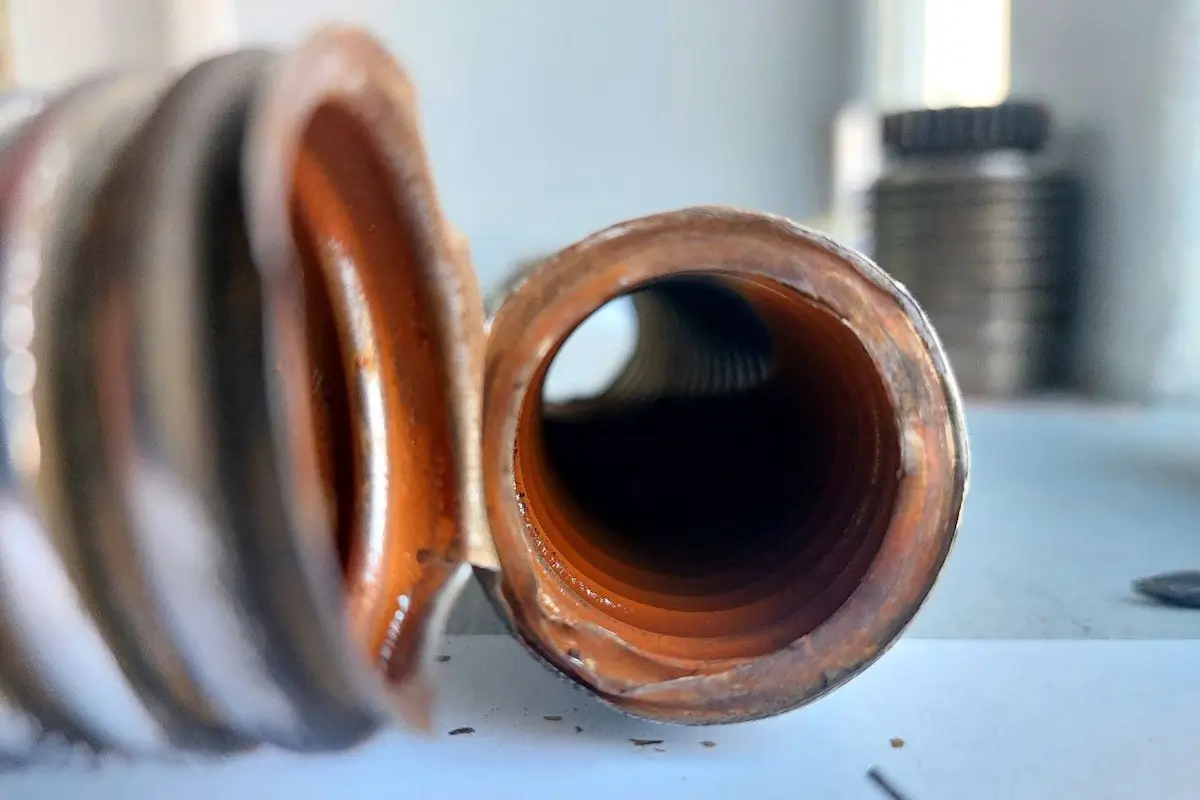
 Modern solar systems operate in difficult conditions: high temperatures, constant pressure drops, exposure to moisture, ultraviolet light and aggressive coolants. That is why corrugated stainless steel metal hoses are often used for their connection. They are characterized by flexibility, temperature resistance, durability, and excellent anti-corrosion properties. However, even stainless steel can corrode under certain conditions.
Corrosion of a metal hose can lead to a decrease in the efficiency of the solar system or even an emergency failure of the equipment. This is especially critical for solar collectors, where the coolant temperature can exceed 150-200°C in stagnation mode.
In this article, we will consider the main causes of corrosion on metal hoses for solar systems and ways to avoid premature damage.
Main causes of corrosion on metal hoses for solar systems
1. Incorrect choice of coolant
The most common cases of rust on metal hoses for solar systems are associated with incorrect use of the coolant. In solar systems, special antifreezes – coolants based on propylene glycol with the addition of corrosion inhibitors are most often used. Such liquids are safe for stainless steel, chemically neutral, and can operate in a wide temperature range (from -30° to +200°C).
But if the liquid contains some impurities, it can contribute to corrosion and begin to destroy the inner surface of the metal hose. For example, long-term operation of the coolant (more than 2-3 years) without replacing it and checking the composition can lead to contamination and sedimentation.
It is forbidden to use tap water or make solutions with it as a coolant for solar collectors. And this is not only due to the small range of operating temperatures. Ordinary water contains various salts, it can be chlorinated. And chlorine is the main “enemy” of stainless steel, their contact is strictly prohibited. Therefore, solutions for solar systems should be made only using distilled water.
Ethylene glycol (car antifreeze) is also not suitable for use in solar systems. Although it has proven itself well when operating at low temperatures, under the influence of high temperatures (above 150°C) it oxidizes and forms an acidic environment, which significantly accelerates corrosion processes.
2. Incorrect selection of stainless steel grade
One of the most common causes of corrosion on stainless steel is the use of alloys with a low chromium and nickel content. This metal has a significantly lower resistance to aggressive environments.
For solar systems, the following grades of stainless steel hoses are most often used:
- AISI 304 – a common and inexpensive grade of stainless steel with high anti-corrosion properties;
- AISI 316L – in addition to chromium and nickel, which give stainless steel anti-corrosion properties, it contains molybdenum, which significantly increases the material’s resistance to aggressive substances such as sea water, acids, chlorides, and condensate, so that metal hoses made of this steel can be used for work in contact with these substances.
We recommend using metal hoses made of AISI 316L steel.
3. Galvanic corrosion
Another common problem is the contact of dissimilar metals. For example:
- stainless steel + ferrous metal;
- stainless steel + aluminum;
- stainless steel + poor-quality brass.
In the presence of moisture, an electrochemical reaction occurs between metals, which accelerates the destruction of the less resistant material. To avoid this, avoid direct contact of dissimilar metals.
4. Corrosion from the influence of stray currents and leakage currents (electrocorrosion)
Stray currents are electric currents that pass through metal structures not along the intended path, but through extraneous conductors, including through metal hoses. They can occur due to:
- faulty grounding;
- damaged electrical wiring;
- incorrect connection of electrical equipment;
- operation of powerful electrical appliances;
- proximity to industrial networks.
If a corrugated hose or metal hose becomes part of an electrical circuit, electrochemical destruction processes begin on the metal surface. Under the influence of electric current, the protective layer of chromium oxide of stainless steel is destroyed, microcracks or pitting corrosion are formed.
To protect the metal hose from stray currents, it is necessary to use a dielectric insert that prevents the electrical contact between the equipment and the pipeline.
5. High temperatures and system overheating
Solar systems regularly operate in extreme temperature conditions. During stagnation of the coolant, the temperature in the collector can be very high, which can cause destruction of the protective oxide layer and local corrosion in stress areas.
For such conditions, it is important to use metal hoses designed specifically for high-temperature use.
6. Installation and operation errors that lead to damage to the protective layer
Stainless steel has a natural passive layer that protects the metal from corrosion. But it can be damaged by using aggressive chemicals for cleaning or during improper installation of the metal hose, when additional mechanical loads are created and local corrosion occurs.
It is important not to neglect the operating conditions of metal hoses for solar systems.
7. Environmental impact (atmospheric corrosion)
The external parts of solar systems can be exposed to:
- rain;
- snow;
- condensate;
- ultraviolet;
- industrial emissions;
- salty air in coastal regions.
Insulation protects against this, but if the metal hose does not have additional protection or the insulation is damaged in some areas, the risk of rust increases significantly.
In which places on the metal hose does corrosion most often occur?
The technological process of manufacturing a metal hose involves welding a metal strip (strip) into a pipe. Arc welding is performed with a tungsten electrode that does not melt in a protective atmosphere of inert gas (argon). Due to this, the formed weld seam does not lose the anti-corrosion properties of stainless steel.
Nevertheless, it is the weld seam that is the weakest point of the metal hose. With poor-quality welding, the crystal structure of the metal at the molecular level can be disrupted, and the boundaries between grains can change. Under the influence of high temperatures during welding, carbon can react with chromium, forming chromium carbide, which precipitates near the grain boundaries. Because of this, over time, the so-called intergranular corrosion of stainless steel may occur, when rust appears along the seam.
Conclusion
Corrosion of stainless steel metal hoses in solar systems can occur for various reasons. Remember that even stainless steel requires proper selection and operation.
A high-quality stainless steel metal hose, professional installation and regular system maintenance can significantly extend the service life of the solar system and avoid expensive repairs.
