
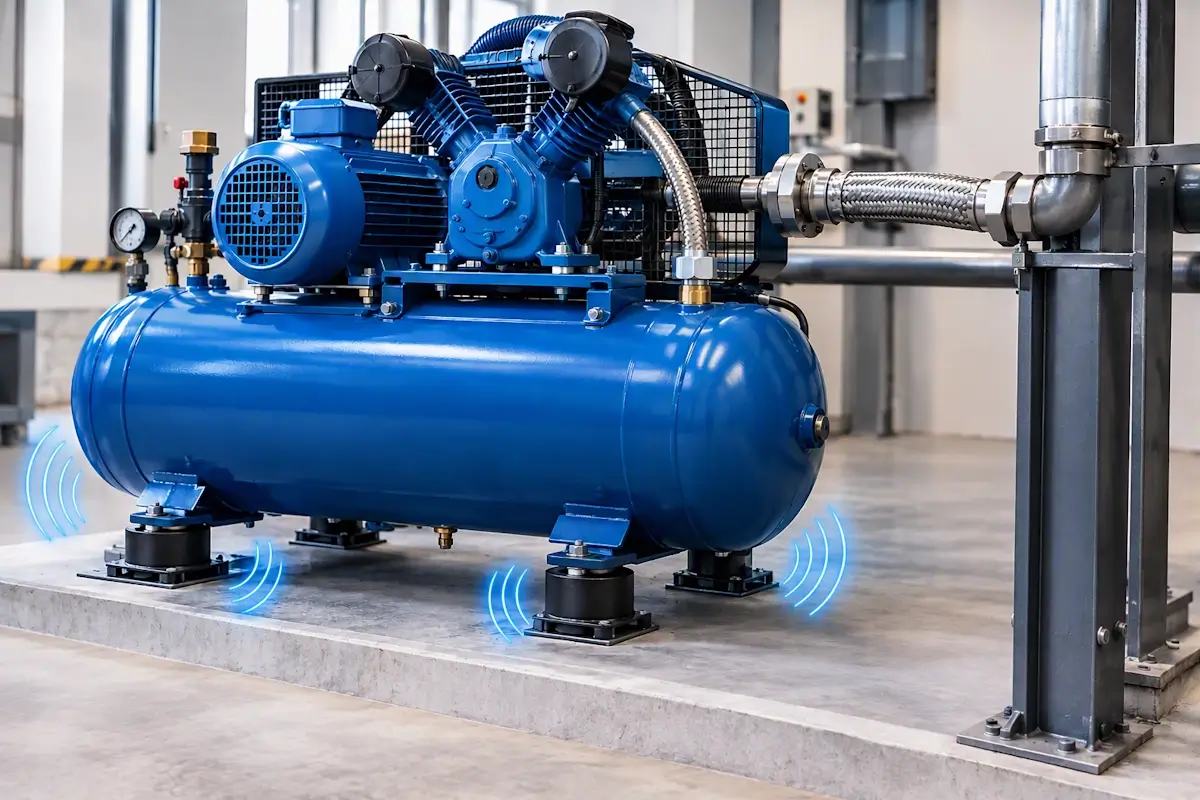
 Compressor vibration is a common problem that can occur during the operation of industrial, refrigeration, and other compressor equipment. Minor fluctuations are a natural consequence of the operation of the motor and mechanisms; however, excessive vibration often indicates faults, improper installation, or insufficient vibration isolation of the equipment.
If the cause is not eliminated in time, vibration loads can lead to accelerated wear of bearings, loosening of fastenings, damage to pipelines, and disruption of the tightness of connections. Therefore, it is important not only to reduce noise but also to identify the source of the oscillations and eliminate it.
Why compressor vibration occurs
The causes of vibration depend on the compressor design, operating conditions, and the method of its installation. Most often, the problem is associated with mechanical faults, imbalance of rotating parts, improper fastening, or transmission of oscillations to pipelines.
1. Improper installation of the compressor
One of the most common causes is improper installation of the equipment. If the compressor is installed on an uneven, insufficiently rigid, or unstable base, additional oscillations occur during operation. Loosened anchor bolts, worn supports, and improper installation of vibration isolation elements also lead to problems.
How to eliminate: check the horizontality of the installation, the condition of the foundation, the reliability of the fastenings, and the correctness of the mounting of the supports. If necessary, appropriate anti-vibration supports are used, selected taking into account the mass of the equipment and the frequency of its oscillations.
2. Imbalance of rotating parts
In compressors with rotating mechanisms, vibration can occur due to imbalance of the rotor, fan, or other moving elements. The cause is contamination, damage to parts, uneven wear, or misalignment. Such oscillations can be especially noticeable as the rotational speed increases.
How to eliminate: perform diagnostics of the rotating assemblies, check the alignment and balancing of the parts. If damaged components are detected, they must be repaired or replaced in accordance with the manufacturer’s recommendations.
3. Wear of bearings and mechanical assemblies
Bearings ensure stable rotation of shafts and absorb mechanical loads. In the case of their wear, insufficient lubrication, or damage, the clearance increases, extraneous sounds occur, and vibration intensifies. Such symptoms may be accompanied by overheating of individual assemblies and increased energy consumption.
How to eliminate: check the condition of the bearings, the lubrication system, and the seating surfaces. Further maintenance or replacement of parts must be performed in accordance with the compressor’s technical documentation.
4. Pressure pulsations in the system
In reciprocating compressors, pressure pulsations occur during compression cycles. They can cause gas oscillations in pipelines and transmit dynamic loads to connections, fittings, and supports. The problem can be aggravated by an unsuccessful pipeline configuration, insufficient rigidity of the structure, or resonance at certain operating frequencies.
How to eliminate: check the operating parameters of the compressor, the pipeline design, and the fastenings. For complex systems, an analysis of pressure pulsations and acoustic oscillations may be required, followed by design adjustments.
If necessary, special pulsation dampers, receivers, or other solutions provided for by the project are used. The choice of equipment depends on the type of compressor, the working medium, the pressure, and the pulsation frequency.
5. Transmission of vibration to pipelines
Even if the compressor is in good working order, its operation can cause oscillations of pipelines connected to the discharge or suction nozzle. Rigid pipe connections transmit mechanical oscillations to adjacent elements of the system, which can lead to noise, loosening of fastenings, and fatigue damage to the metal. It is especially important to take this factor into account in refrigeration units, air conditioning systems, industrial compressor stations, and pneumatic systems.
How to eliminate: check the pipeline supports, fastenings, alignment of connections, and the presence of excessive mechanical stresses. One way to reduce the transmission of vibration is to install special flexible metal hoses or vibration compensators designed for the relevant operating conditions.
6. Improper operating mode
Vibration can intensify due to operation outside the recommended parameters. Excessive load, frequent starts and stops, unstable pressure, or improper performance regulation can create additional mechanical loads.
How to eliminate: check the operating pressure, temperature, performance, and start frequency. The parameters must be brought into compliance with the requirements of the compressor manufacturer and the technological process.
How to reduce compressor vibration
To effectively eliminate the problem, it is necessary to combine technical diagnostics with proper installation and the use of appropriate vibration isolation elements. The main measures:
- Checking fastenings. It is necessary to make sure that the compressor, supports, and pipelines are securely fastened.
- Installation of anti-vibration supports. They help reduce the transmission of oscillations from the equipment housing to the foundation or load-bearing structure.
- Regular maintenance. Checking bearings, drives, the lubrication system, and other assemblies allows faults to be detected at an early stage.
- Checking pipelines. It is important to eliminate misalignments, excessive loads on the nozzles, and improper fastening of pipes.
- Use of flexible connections. Special metal hoses and vibration compensators can reduce the transmission of mechanical oscillations through pipeline connections.
- Control of operating parameters. Pressure, temperature, and performance must correspond to the permissible values for the specific equipment.
One should not try to eliminate any vibration merely by installing additional supports or flexible connections. If its source is a mechanical fault of the compressor, that particular fault must be eliminated first.
Metal hoses and vibration compensators for compressor systems
Flexible stainless steel metal hoses and special vibration compensators are used in pipeline systems where it is necessary to reduce the transmission of mechanical oscillations, compensate for small movements of equipment, or reduce the load on connections. Unlike rigid pipes, a flexible design, with proper selection, can provide a certain mechanical decoupling between the compressor and the pipeline. This helps reduce the transmission of part of the vibration loads and compensate for minor installation displacements.
When choosing a metal hose or vibration compensator, it is necessary to take into account:
- Working pressure. The product must withstand the maximum pressure in the system, taking into account possible pulsations and transient conditions.
- Medium temperature. The materials and design must correspond to the working and permissible temperature range.
- Type of working medium. It is necessary to check the chemical compatibility of the materials with air, refrigerant, oil, or another medium.
- Diameter and type of connections. It is important to correctly select the flow cross-section, threads, flanges, or other end elements.
- Nature of the vibration. The frequency, amplitude, and direction of oscillations influence the choice of the flexible connection design.
- Installation conditions. The length, bending radius, installation direction, and permissible movements must correspond to the manufacturer’s recommendations.
It is important to distinguish between a general-purpose metal hose and a special vibration damper (vibration compensator). Not every flexible metal hose is designed for long-term operation under cyclic loads or for effective absorption of vibrations. For compressor systems, it is necessary to choose a product whose characteristics are confirmed for the specific operating conditions.
It should also be taken into account that a metal hose does not replace proper fastening of pipelines, anti-vibration supports, or special devices for damping pressure pulsations.
How to determine the source of compressor vibration
Before choosing a method for eliminating vibration, it is necessary to determine where exactly it originates. To do this, one can sequentially check several main sections of the system.
- Inspect the foundation and fastenings. Check the stability of the compressor, the condition of the supports, and the presence of loosened connections.
- Assess the nature of the noise and oscillations. Extraneous knocking, grinding, or a sharp intensification of vibration may indicate a mechanical fault.
- Check the pipelines. Determine whether oscillations are transmitted to the pipes, fittings, and other structures.
- Check the operating parameters. Compare the pressure, temperature, and performance with the permissible values.
- If necessary, perform instrumental diagnostics. Measuring vibration velocity, vibration acceleration, and the frequency spectrum helps to more accurately determine the source of the oscillations.
If the vibration has sharply intensified, impacts, overheating, or signs of pipeline damage have appeared, the equipment must be safely stopped in accordance with the manufacturer’s instructions, and a technical inspection must be organized.
Conclusion
Compressor vibration can occur due to improper installation, imbalance of rotating parts, wear of bearings, pressure pulsations, or transmission of oscillations to pipelines. To eliminate the problem, it is necessary to determine its root cause and select appropriate technical solutions.
Regular maintenance, reliable fastening of equipment, correctly installed anti-vibration supports, and properly designed pipelines help reduce vibration loads. Under appropriate conditions, special flexible metal hoses and stainless steel vibration compensators can be an additional solution.
The correct selection and installation of these elements contribute to reducing the transmission of oscillations to pipelines, reducing the load on connections, and increasing the reliability of the compressor system.
