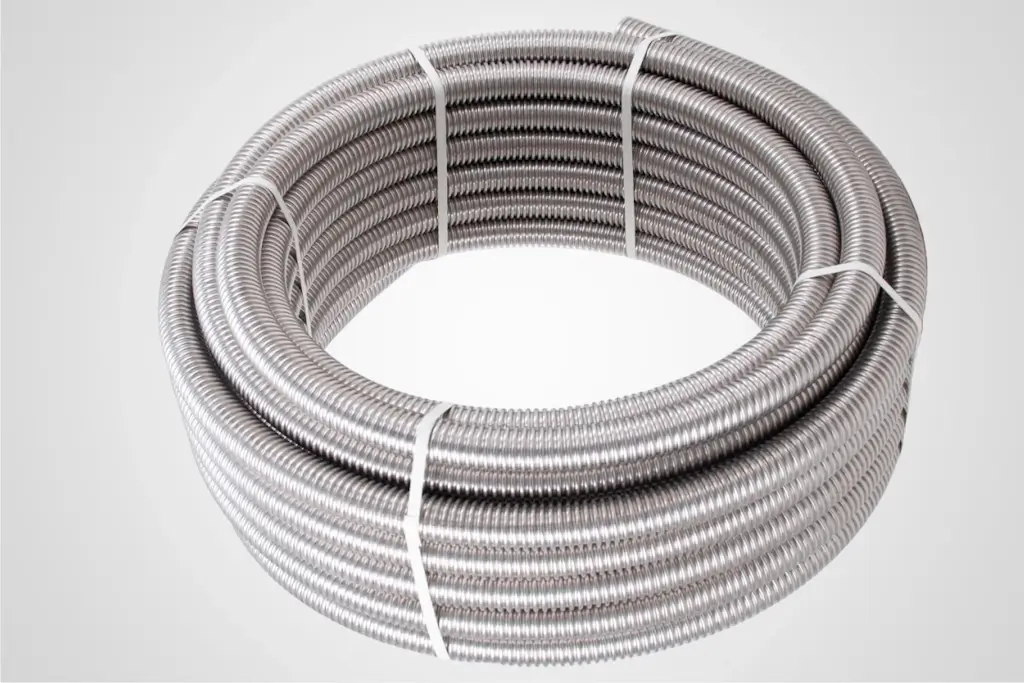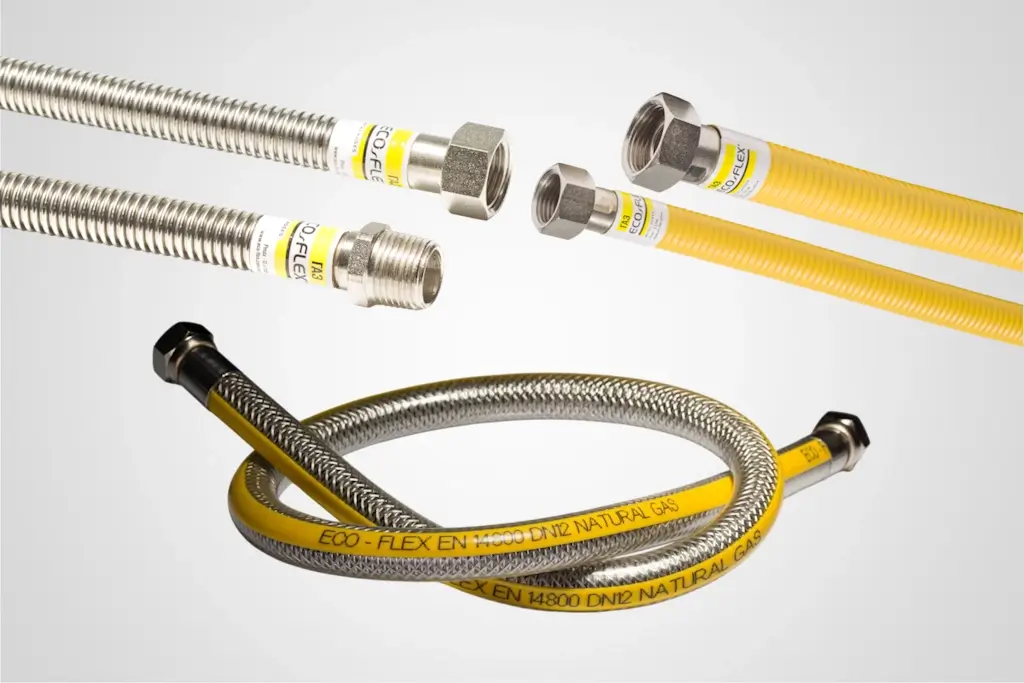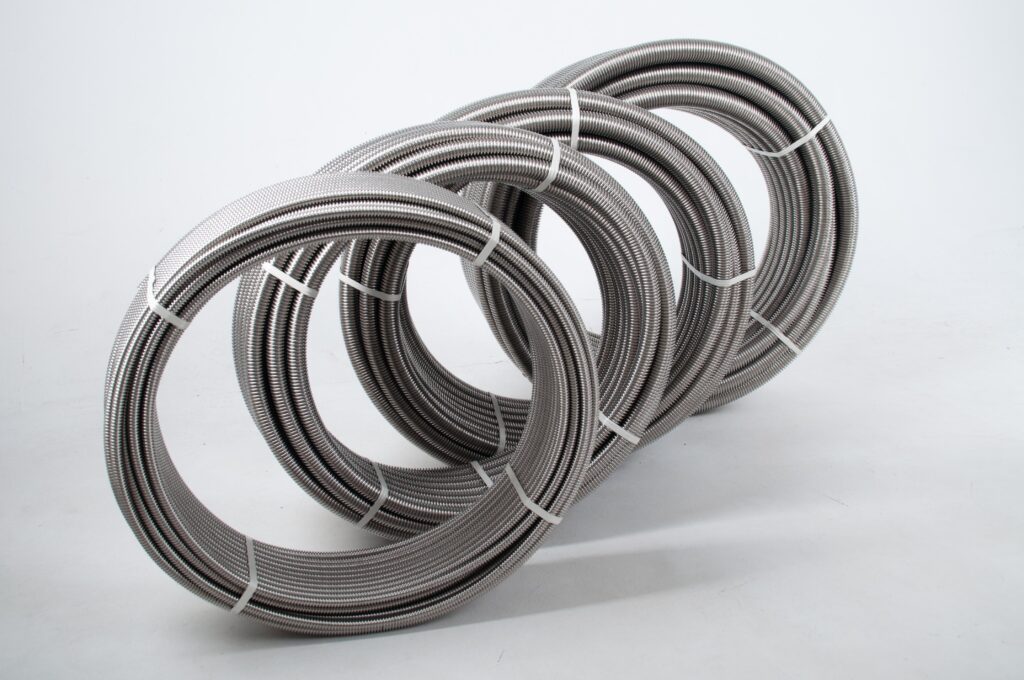
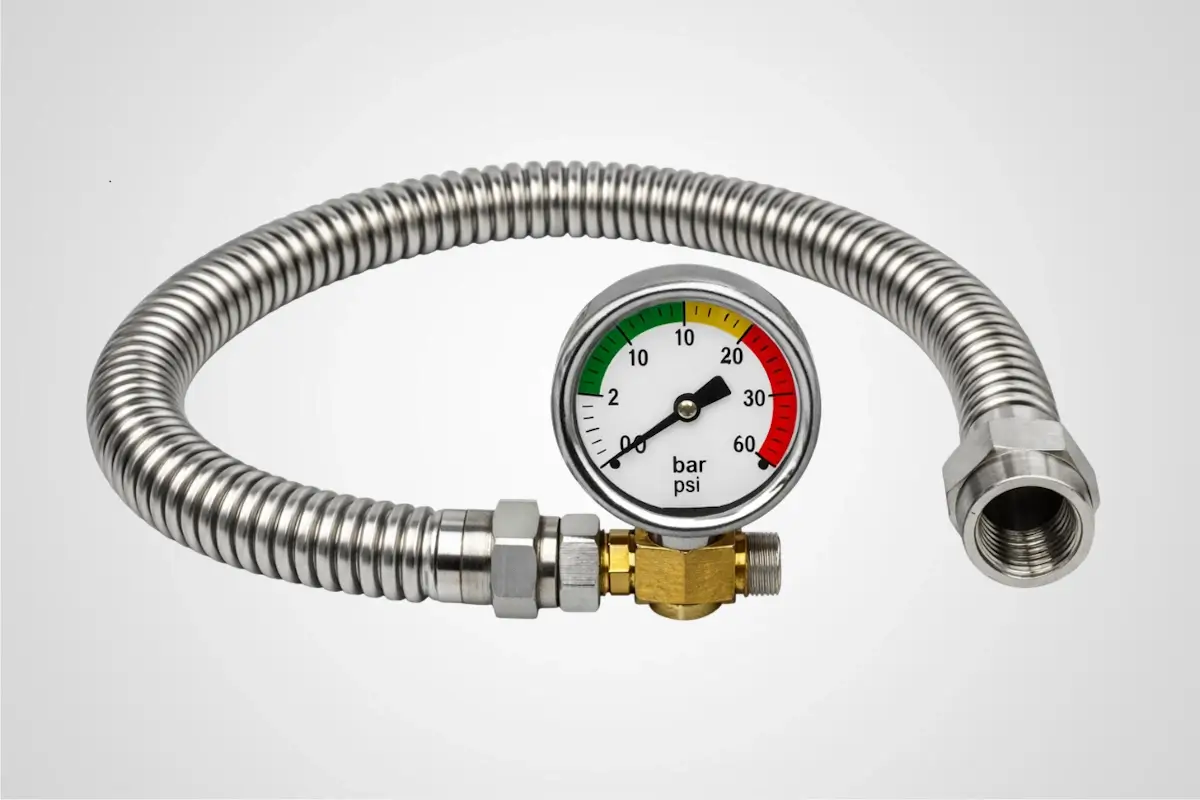
Corrugated stainless steel hoses and metal sleeves are a versatile solution for connecting gas, water, heating, and industrial equipment. One of the most frequently asked questions from customers is: what pressure can they actually withstand?
In this article, we’ll discuss working and maximum pressure, as well as factors affecting product strength.
Working and burst pressure: what’s the difference?
Working pressure is the maximum pressure at which a hose can safely operate throughout its service life.
Burst pressure is the critical level at which the product fails. It is typically 3-4 times higher than the working pressure.
For example:
- Domestic stainless steel gas hoses: up to 0.05-1.0 MPa (0.5-10 bar).
- Water supply and heating hoses: up to 1.0-1.6 MPa (10-16 bar).
- Industrial metal hoses with braiding: up to 10-30 MPa (100-300 bar) and more (depending on the design).
What does the permissible pressure depend on?
1. Wall thickness and corrugation profile
The greater the metal thickness, the greater the safety margin. The corrugation type is also important. The Eco-Flex hose and metal hose range includes three corrugation types:
- Closed – the most flexible hoses and metal hoses, withstanding low pressure;
- Standard – moderate flexibility and pressure;
- Open – least flexible, highest pressure.
The geometry of the corrugation directly impacts the ability to withstand internal pressure.
2. Presence of braiding
Unbraided metal hoses can withstand significantly lower pressures. The presence of one or two layers of steel braid:
- reduces axial elongation;
- increases permissible pressure;
- increases service life under pulsation.
Therefore, high-pressure hoses (up to 300 bar) always have a reinforced design.
3. Hose diameter
As the internal diameter increases:
- the load on the walls increases;
- the permissible working pressure decreases.
This means that a hose with a diameter of 12 mm can withstand greater pressure than a similarly designed hose with a diameter of 32 mm.
4. Temperature of the environment
As the temperature rises:
- the metal’s tensile strength decreases;
- the permissible pressure decreases.
For example, at +20°C, a hose can operate at 16 bar, but at +300°C, the permissible pressure can decrease by 20–30%.
5. Type of environment
Gas, water, steam, oil or aggressive chemicals have different effects on the material.
How is working pressure calculated?
To accurately determine the working pressure, the following factors are taken into account:
- diameter;
- wall thickness;
- number of braid layers;
- temperature;
- medium type;
- safety factor.
As a manufacturer of stainless steel hoses and metal conduits, Eco-Flex conducts hydraulic testing of its products. Specification tables are provided on the product pages.
Why is it important not to exceed the operating pressure?
Exceeding this limit leads to:
- plastic deformation of the corrugated pipe;
- reduced service life;
- risk of depressurization;
- emergency situations.
This is especially critical for gas systems.
Conclusion
Thus, stainless steel hoses and metal sleeves can withstand pressures ranging from a few bars in domestic systems to hundreds of bars in industrial applications. When choosing, it’s important to consider not only the maximum pressure but also the operating conditions and safety margin.